Perspectives
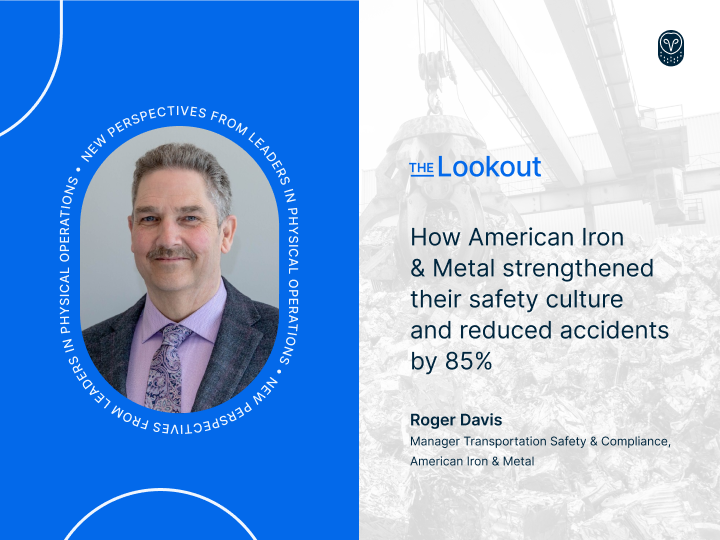
How American Iron & Metal strengthened their safety culture and reduced accidents by 85%
December 16, 2025

Manager Transportation Safety & Compliance, American Iron & Metal
Get the latest from Samsara
Subscribe nowMy career has taken me to nearly every corner of the transportation industry. I started out as a heavy truck mechanic, where I learned early on that safety is shaped long before a truck ever hits the road; it begins with the condition of the equipment and the care that goes into maintaining it. Later, my work in risk management with the Ministry of Transportation introduced me to the enforcement side of the industry: how risk is assessed, how fleets are evaluated, and how quickly operational inconsistencies can turn into compliance issues.
Those experiences shaped a belief that still guides me today: compliance alone does not create safety—culture does.
When I joined the Canadian team at American Iron & Metal—a global operation spanning 10 countries and 135 locations—we had an incredibly dedicated group of people working to keep our employees safe. What we didn’t have was a comprehensive, scalable safety program. We lacked visibility, we had operational gaps we couldn’t monitor, and it was clear we needed to build a stronger safety culture from the ground up.
In the years since, we’ve worked hard to change that. Today, our accident rate is down 85%, our compliance has improved, and our teams have the information they need to make safer decisions every day. The practices below were essential in helping us get there.
1. Establish a shared safety vision supported by data
In risk management, I learned a fundamental truth: culture trickles down. You can’t build a meaningful safety program unless the people at the top are genuinely engaged. And in my experience, if leadership believes something is important, it becomes important to everyone.
The challenge is earning that buy-in, and the most effective way to do that is by speaking the language senior leadership understands best: data. That became feasible when we installed Samsara.
We focused on three core approaches to track our progress. First, and most importantly: nobody gets hurt. By that, I mean every person connected to our operations gets home safely at the end of the day. Second, we monitor how the government measures us, using our Commercial Vehicle Operator’s Registration rating in Ontario as a clear benchmark. And third, we track both the frequency and the severity of incidents across the fleet.
When we shared these metrics from the Samsara platform with senior leadership, they could immediately see what was at stake. This increased commitment to safety then spread through the organization—from managers to drivers—until we were all moving in the same direction.
2. Use real-time feedback to reinforce safe driving habits
With a fleet of our size, even small driving habits can create significant risk. When we began measuring our performance, we discovered an average of 32 speeding events every day—each one recorded at 20 km/h over the posted limit. To address this, we introduced in-cab alerts, which allow drivers to adjust their behaviour in real time. When Samsara alerts the driver, it interrupts fatigue, routine, or distraction and prompts a safer choice.
The impact was immediate. Within two months, speeding events dropped from 32 per day to none, and rolling stops fell from 28 per week to fewer than five per month.
But the most meaningful change was cultural. We knew we were making real progress when a driver told us he corrected his behaviour, not because he was worried about a ticket, but because he didn’t want to let the team down. That moment made it clear that we were moving beyond simple compliance and building a culture where people genuinely wanted to do the right thing.
3. Build trust through a transparent maintenance process
As a heavy truck mechanic by trade, I know the frustration of operating under a “fix it when it breaks” mentality. Drivers feel the same way when they report a defect and never hear whether it was resolved.
Digitizing our DVIR process changed that. Defects are now recorded immediately, tracked through repair, and verified as completed—visibility that drivers can see for themselves. Mechanics can focus on repairs instead of paperwork, and drivers report issues more consistently because they see their concerns being acted on.
This shift strengthened both safety and reliability. It also reduced the risk of enforcement issues; recurring maintenance problems are easy for inspectors to spot, and avoiding those patterns helps prevent audits.
4. Empower your teams to make informed decisions under pressure
In logistics, urgency is a constant. When things go wrong, the instinct can be to panic and take shortcuts—sometimes unsafe, sometimes non-compliant. We needed to shift that mindset. My message to operations was simple: a smart person can solve the problem without breaking the rules. The work still has to get done, but it has to be done safely every single time.
Technology gave us the tools to support that approach. With 3,000 trailers and rapid growth, asset tracking helped us to locate equipment instantly, removing the wasted time that often leads to rushed decision-making. By relying on data instead of guesswork, we significantly reduced unnecessary risks—and ultimately brought our reportable accidents down by 85%.
Waiting until after a breakdown or incident to review information is too late. At that point, you’re reacting, not managing. The goal is to use data proactively—to flag issues early, adjust plans sooner, and prevent incidents before they happen.
It all comes down to the same principle: get ahead of the problem so everyone makes it home safely.
Ready to take your operations to the next level? Schedule a demo to see how connected operations can drive real impact—or log in to unlock more value from your existing Samsara platform.
Get a demoGet the latest from Samsara
Subscribe nowRead more

How Sobeys modernized national fleet maintenance and unlocked actionable insights with AI

National Fleet Manager, Sobeys

Using technology to improve compliance, equipment tracking, and safety across Western Canada

VP of Fleet Services, Freight North Group of Companies

How tappCONNECT is scaling safer, more efficient passenger transit

Chief Operating Officer, tappCONNECT

How Sunrise Farms’ Director of Fleet and Livehaul led digital transformation with a lean team

Director of Fleet and Livehaul, Sunrise Farms
Why thousands of companies in the retail industry choose Samsara

EVP, Chief Operating Officer - GTM

Canada’s most dangerous winter roads

Head of Insights

Caron Transportation Systems’ Dieter Blank on why safety starts with smart tech

Sr. Director, Customer Marketing

Sterling Crane Canada on transitioning to proactive maintenance to overcome harsh conditions

Regional Maintenance Manager, Sterling Crane Canada

Women at the wheel: How tech unlocks new opportunities in Canadian trucking

Vice-président principal, EVO Transportation et évangéliste Samsara