Perspectives, Efficiency
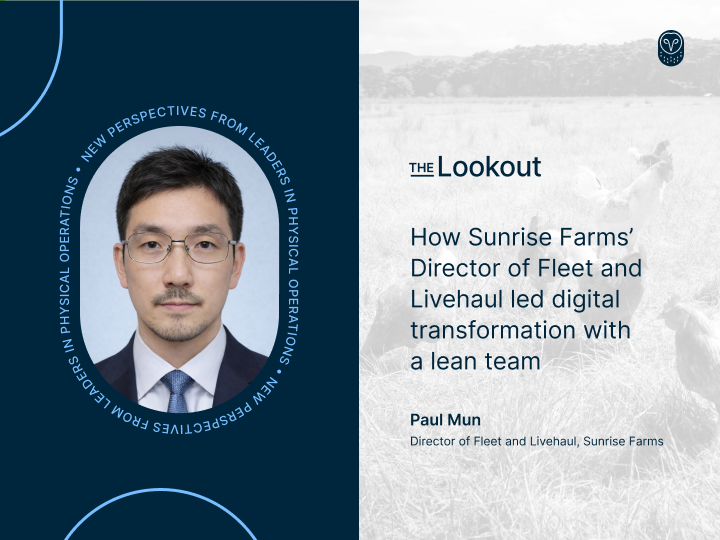
How Sunrise Farms’ Director of Fleet and Livehaul led digital transformation with a lean team
March 19, 2026

Director of Fleet and Livehaul, Sunrise Farms
Get the latest from Samsara
Subscribe nowAs Director of Fleet and Livehaul at Sunrise Farms, I oversee fleet and live-haul operations across 13 processing plants nationwide. Our operation covers the full poultry lifecycle—from transporting hatching eggs to delivering finished products to major international brands. From hatchery to final delivery, we’re accountable for every step. That means transportation reliability doesn’t just affect schedules—it directly impacts product quality, customer relationships, and keeping day-to-day operations moving.
Over the years, we’ve expanded significantly through acquisitions. Growth brought opportunity, but it also brought a mix of legacy systems, inconsistent reporting, and regional processes that weren’t always aligned. Managing a national fleet of more than 200 pieces of equipment in that environment requires more than oversight. It requires visibility you can trust.
For us, digital transformation has been about building that visibility and making sure everyone is working off consistent, reliable data to support safety, efficiency, and long-term planning. As a lean fleet team, I work closely with operations, IT, finance, and regional logistics leaders to make that happen. Together, we’ve integrated telematics, routing APIs, and a Computerized Maintenance Management System (CMMS) across our network. Connecting those systems has allowed us to move from reacting to issues after they happen to making decisions based on real-time data.
Here are five lessons that have shaped our approach.
1. Consolidate fragmented systems to create a single source of truth
At one point, I was managing five separate telematics providers across our fleet. Each system reported data differently, which made it difficult to compare performance, identify trends, or apply consistent standards nationwide. We were spending more time reconciling data than actually using it.
Consolidating onto a single telematics platform gave us one reliable source of truth. Almost immediately, we were able to evaluate fleet performance across regions using the same benchmarks. That visibility allowed us to make decisions with greater confidence.
When selecting a partner, I prioritized an intuitive graphical user interface. Regional teams need tools that are simple and practical to use. If a system is overly complex, adoption suffers—and without adoption, the data doesn’t translate into improvement. In this case, simplicity drives consistency, and consistency drives results.
Responsive support was equally important. With a lean internal team, having a dedicated account manager who responds quickly helps us resolve issues efficiently and keep initiatives moving without stretching resources too thin.
2. Address driver concerns through transparency and focused coaching
Implementing in-cab AI cameras required thoughtful change management. Drivers understandably have concerns about privacy and monitoring, and those concerns need to be addressed directly.
We started by putting clear governance policies in place. Video access is restricted to management, and we communicated exactly how footage would—and would not—be used. Establishing those guardrails early helped build trust and set the right expectations.
Over time, examples such as a severe winter storm in Winnipeg helped reinforce the value of the technology. In that incident, one of our drivers was involved in a multi-vehicle collision that received public attention. Dash cam footage confirmed he was driving safely—70 km/h in a 100 km/h zone with high beams on—and he was fully exonerated. Situations like this, along with other exoneration cases, helped demonstrate that the system protects drivers just as much as it protects the business.
We’ve also evolved our coaching approach. Rather than relying on outdated safety materials, we use relevant event footage to guide focused, one-on-one discussions. Grounding feedback in actual driving data makes conversations more objective, more constructive, and ultimately more effective.
3. Adapt technology to regional realities
Operating a national fleet means risk isn’t uniform—it changes by geography, route, and operating environment. In Alberta, our drivers regularly travel the 500-kilometre corridor between Edmonton and Lethbridge, an area known for strong crosswinds. When you combine those winds with nighttime live-haul operations and 53-foot trailers, rollover risk becomes a serious operational concern.
To address that risk, we implemented dual-facing dash cams and AI-powered drowsiness detection. This gave us better visibility into fatigue and driving conditions, allowing us to coach proactively rather than react after an incident. With improved monitoring and targeted coaching, trailer tip-over incidents declined to zero.
In British Columbia, the risks look very different. Urban density introduces its own challenges. Operating 49-foot trailers in tight city environments increases exposure to side-swipes and wide-turn collisions. Deploying 360-degree multicams provides full visual context during incident reviews, supporting fair liability assessments and stronger driver protection.
The key lesson is that technology should reflect operating conditions. A standardized fleet doesn’t mean a standardized risk profile. Matching the solution to how we actually operate has been essential to improving safety performance across our entire fleet.
4. Strengthen supply chain integrity with real-time environmental monitoring
Our live-haul operations—particularly transporting live chicks—require precise environmental control. Even minor temperature deviations can impact animal welfare and disrupt downstream operations.
Our initial attempt to monitor trailers using traditional cameras didn’t provide the level of environmental oversight we needed. We transitioned to live environmental sensors that track real-time temperature data and trigger automated alerts if HVAC or reefer systems fall outside acceptable ranges. That shift allows us to respond immediately, often before a small issue becomes a larger operational problem.
The same monitoring capability strengthens our finished goods distribution. Many of our retail partners maintain strict temperature compliance standards, and accountability extends across the entire cold chain. Maintaining independent, accurate temperature records allows us to verify transport conditions if spoilage claims arise. In several cases, documented data has helped resolve questions quickly, protect customer relationships, and avoid unnecessary financial exposure.
5. Use centralized data to guide efficiency and long-term asset planning
One of the most tangible results of unifying our fleet data has been improved fuel efficiency. By reviewing fuel consumption trends across truck models, routes, and driver behaviours, we were able to pinpoint specific issues—like harsh acceleration—and identify equipment that wasn’t performing as expected.
Instead of applying broad fuel policies, we used that data in practical ways. We introduced targeted coaching plans to address behaviours like harsh acceleration, and we used side-by-side model comparisons to evaluate which trucks were delivering the best fuel performance.
Coaching helped lower baseline fuel consumption, but the more significant long-term savings came from our equipment decisions. By using centralized data to guide new vehicle purchases and replacement timing, we improved overall fleet efficiency and reduced annual fuel spend by approximately $70,000.
The next area I’m focused on is strengthening our maintenance process through a CMMS integration. We’re digitizing work orders, tracking warranty repairs, and monitoring service intervals based on engine hours and mileage so we can stay ahead of breakdowns instead of reacting to them.
Over time, having reliable per-vehicle cost data will give us clearer insight into repair versus replacement decisions and help ensure we’re getting consistent performance from our vendors.
Ready to take your operations to the next level? Schedule a demo to see how connected operations can drive real impact—or log in to unlock more value from your existing Samsara platform.
Get a demo
Get the latest from Samsara
Subscribe nowRead more

Introducing Samsara MCP: your data, inside of your team’s AI tooling

VP, Product Management

September product updates: 4 new Samsara releases to close gaps in your operation

Director, Product Marketing


Commercial Navigation: Ensure your drivers navigate safely and with confidence

Staff Product Marketing Manager

– 8 min read
May product updates: New Samsara releases to help you improve efficiency
Director, Product Marketing

Using technology to improve compliance, equipment tracking, and safety across Western Canada

VP of Fleet Services, Freight North Group of Companies

How tappCONNECT is scaling safer, more efficient passenger transit

Chief Operating Officer, tappCONNECT

8 ways for fleets to manage surging fuel costs

Staff Product Marketing Manager

How CFOs can unlock millions in savings with operational data insights

Enterprise Sales Director, Canada