New Features, Safety
Tachograph laws for LCVs: How to protect your fleet from disruption
April 21, 2026

Senior Product Manager

Get the latest from Samsara
Subscribe nowCross-border freight in Europe is about to get safer. But are you prepared for it to get slower too?
On 1 July 2026, new rules under the EU Mobility Package I will bring drivers of light commercial vehicles (LCVs) weighing above 2.5 tonnes and used for international freight transport or cabotage under the scope of EU Drivers’ Hours regulations. To enforce these rules, all impacted vehicles must be fitted with second-generation smart tachograph devices that record drivers’ hours.
This new regulation aims to address the ‘epidemic’ of fatigue plaguing professional drivers across Europe. Yet it may upend the cross-border road freight’s whole commercial model, while leaving unprepared fleets drowning in admin.
Operators still have a short window to reduce disruption and protect their drivers—as long as they move fast.
What do the new tachograph laws for vans stipulate?
The mandate, part of the EU Mobility Package, limits working drivers to a maximum of nine hours on the road per day—extendable to 10 only twice a week. Drivers must also take a 45-minute break after every four-and-a-half hours of driving.
On a weekly basis, driving time is capped at 56 hours, and 90 hours across any two consecutive weeks. The rules also stipulate 11-hour daily rest periods and unbroken 45-hour weekly rests (and, in many cases, regular weekly rest periods), which cannot be taken inside vehicles.
It’s up to drivers to operate vehicle tachographs. If the tachograph breaks down, or they work away from their vehicle without their card inserted, they are responsible for manually inputting the missing data.
On top of this, drivers will need to have their card on them at all times, with 56 days of records to show in case of an inspection.
Protecting your drivers during the transition
The first task for transport managers is to get their drivers used to the existence of tachographs in the first place. From July 2026, hundreds of thousands of drivers accustomed to ploughing through long shifts will suddenly have a device in their vehicles designed to stop them doing so.
The mandate is a necessary response to the 2,311 annual fatalities caused by LCVs on European roads. During the transition period, mistakes may be inevitable. But typical tachograph devices are set up to record breaches, not avert them. This still leaves drivers vulnerable to all the risks of fatigue.
Beyond the safety implications, there are severe financial costs. With an average £362 penalty per infringement, one driver still adjusting to the rules could rack up thousands in fines in just a few weeks. Multiply this over even a small fleet and you’re losing big sums. After infringements breach a certain threshold, authorities will ask questions about your Operator’s Licence. No company can afford for this to happen.
Overcoming admin overload
Smart tachographs are very advanced pieces of tech. But most of them aren’t built to help with your compliance workflow.
Managers still have to manually pull data every 90 days, and read the driver's smart card every four weeks. Turning this raw data into an infringement report can take weeks. Managers must then print the report, investigate and coach drivers who have committed infringements, secure their physical signature, and file the paper away for at least 12 months.
If a DVSA inspection finds that records are missing or incomplete, this can lead to enforcement action, including fines of up to £5,000 per offence—and, in serious and repeated cases, potential action against your operating licence.
How new tachograph laws could disrupt your business model
The regulation won’t come without costs for the sector as a whole. European cross-border road freight is a €200 billion+ industry whose participants compete on speed above all. Given a third of buyers now expect two-to-three day delivery times from other EU countries, long stints behind the wheel have become all too commonplace.
From this summer, that comes to an end. If your business model relies on meeting ambitious deadlines, you should assess whether your SLAs can still hold once drivers have to take mandated breaks.
Operators have weathered many regulatory changes, and will adapt to this one too. But your commercial success depends on finding the safest, most efficient route towards year-round compliance.
An integrated tachograph solution for LCVs
To survive the 2026 mandate without haemorrhaging revenue, fleets need a way to prevent infringements and rescue their compliance records from faulty filing cabinets.
Enter Samsara Smart Compliance, built in partnership with tachograph market leaders VDO.
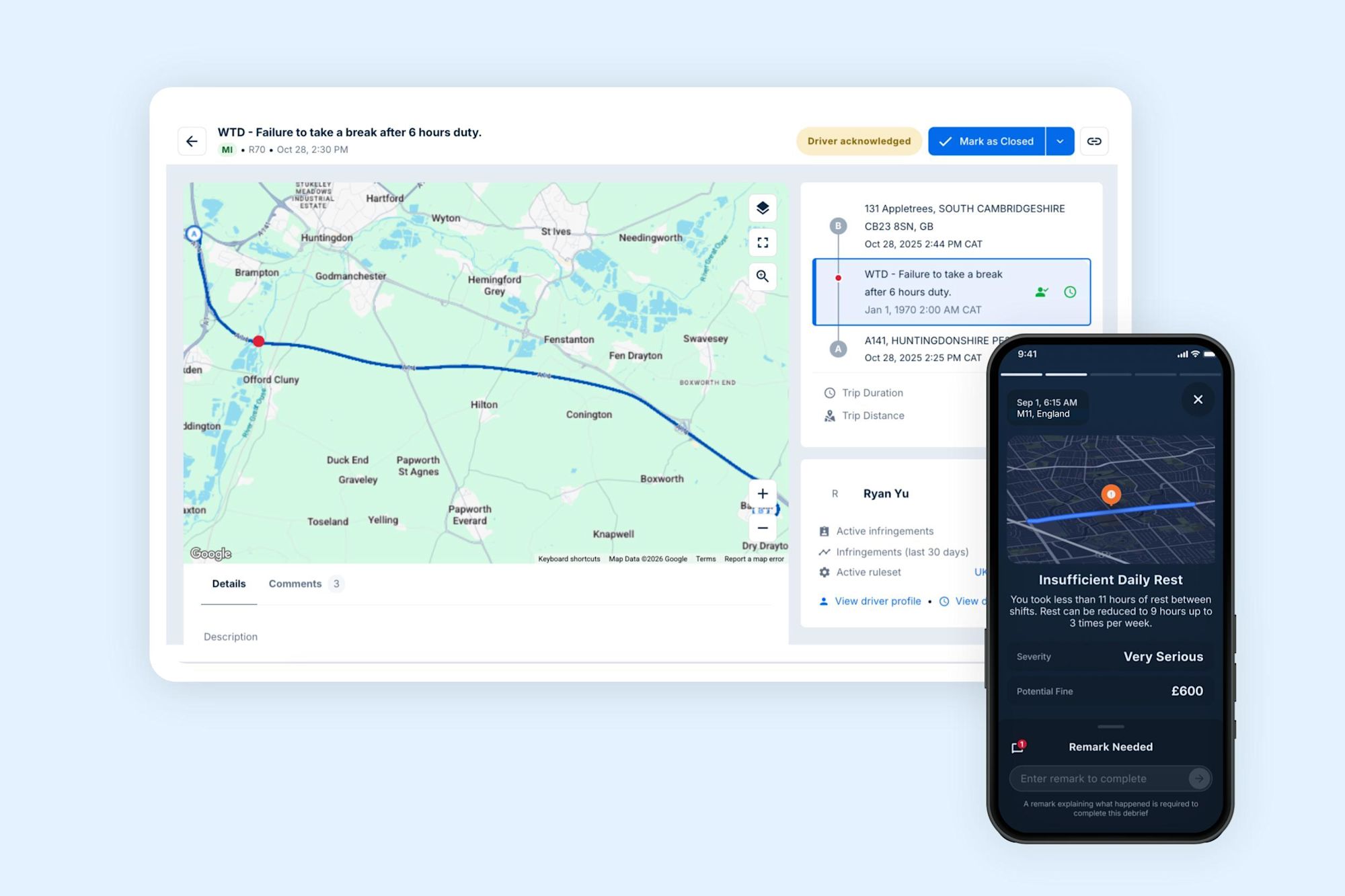
Smart Compliance supports a more proactive approach to safety and compliance by alerting drivers when they’re approaching their limit—before a breach occurs, not after. When infringements do happen, the system enters them into a digital workflow, so you can flag and resolve them the same day they happen
Fleets that have already made the switch are seeing the difference. Take Mulgrew Haulage, a major UK cross-channel logistics provider operating 250 vehicles. Their transport managers used to be trapped in a cycle of retrospective reporting and document chasing.
“Before Smart Compliance, we were always looking back at last month’s infringements,” said Matt, a transport manager at Mulgrew. “Now we review yesterday’s, deal with them immediately, and send them straight to the driver digitally.”
If a driver breaches a limit, the infringement is flagged. With a single click, the manager routes it to the Samsara Driver App. The driver reviews the event, types their explanation, and signs digitally on their smartphone, creating a durable, cloud-based audit trail. As Matt says, “now everything is in one place - the infringement, manager response and driver acknowledgement”.
Smart Compliance's licence model is designed to align billing with vehicles and actual usage, helping reduce the risk of paying for long zero-infringement periods, or for reports on drivers who've left the business.
Future-proof your fleet before 1 July
The new tachograph rules will deliver a sharp shock to the European LCV industry. Less prepared operators will struggle to cope with the deluge of admin. But you can buck the trend and protect your operations, your drivers, and your margin.
Ready to find out how Smart Compliance works? Join us on 7 May at 10 a.m. GMT for our special webinar, Goodbye penalties: See Smart Compliance in action. Matt Crosland, UK Area Manager at Mulgrew Haulage Ltd will walk you through how Mulgrew uses AI-based workflows to make tachograph compliance quick and easy for all their staff.
Sign up nowThis article is provided for general information only and does not constitute legal advice. Tachograph and drivers’ hours obligations can vary by country, operation type, and over time. Operators remain responsible for complying with applicable laws and should consult official guidance and their own legal advisors for advice on specific situations.
Get the latest from Samsara
Subscribe nowRead more

October product updates: 2 new Samsara releases to put every asset to work

Director, Product Marketing

Turn operational data into action with Samsara
Staff Product Marketing Manager, AI

How to help a driver in need

Regional Staff Solutions Marketing Manager

Introducing Samsara MCP: your data, inside of your team’s AI tooling

VP, Product Management

September product updates: 4 new Samsara releases to close gaps in your operation
Director, Product Marketing

How passenger fleets can prove their duty of care
Regional Staff Solutions Marketing Manager

August product updates: 5 new Samsara releases to help you turn insights into action
Director, Product Marketing

EBPMS explained: why compliance is the floor, not the ceiling

Group Manager, Product Marketing

Built by you, for you: The new Samsara Community

Principal Community Manager