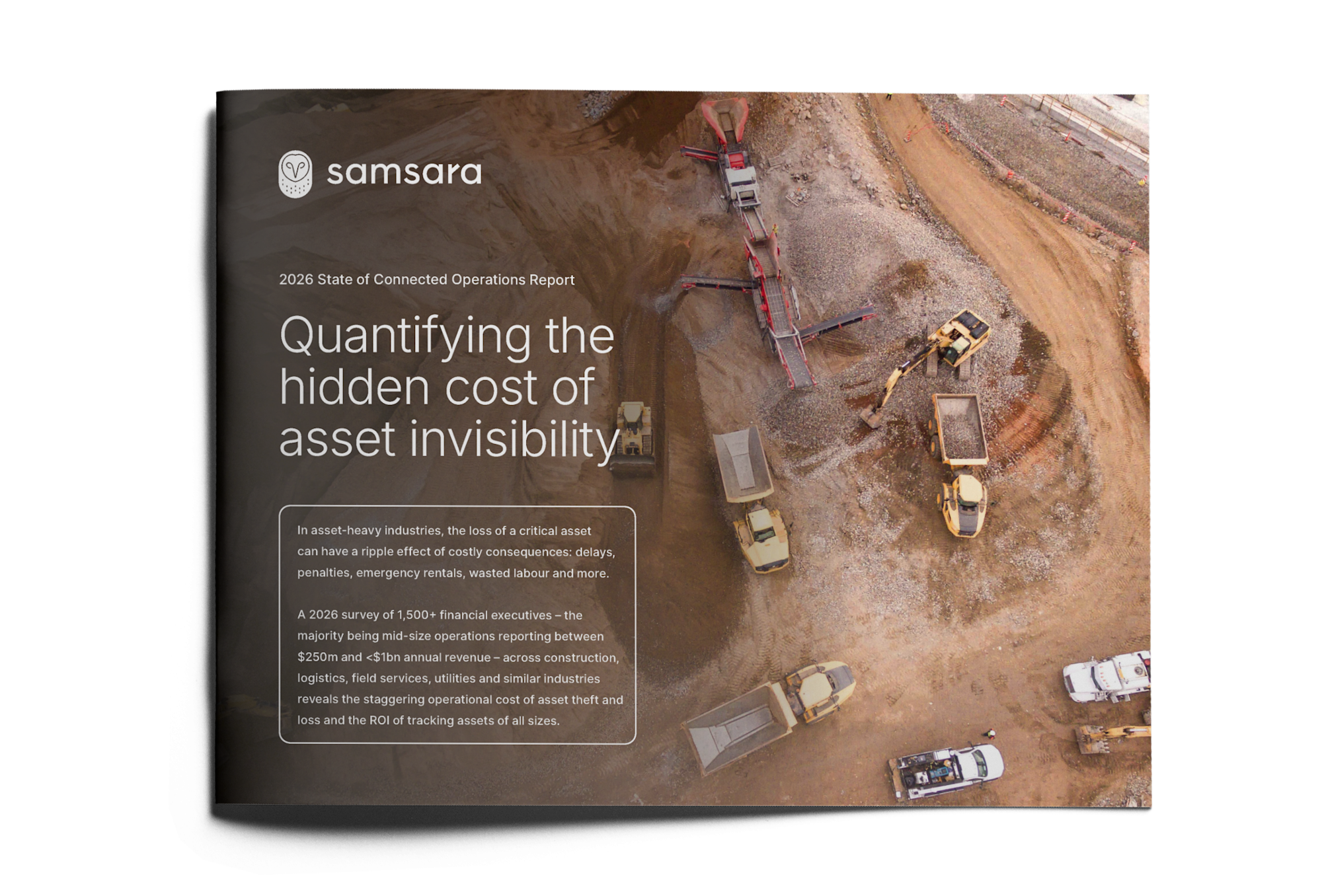

2026 STATE OF CONNECTED OPERATIONS REPORT
Quantifying the hidden cost of asset invisibility
Download the PDF reportIn asset-heavy industries, the loss of a critical asset can have a ripple effect of costly consequences, including project delays, penalties, emergency rentals, wasted labour and more.
A 2026 survey of 1,500+ financial executives – the majority being mid-size operations reporting between £180m and <£740m annual revenue – across construction, logistics, field services, utilities and similar industries reveals the staggering operational cost of asset theft and loss and the ROI of tracking assets of all sizes.
Respondents without asset tracking self-reported losing an average of
£9.7m
annually as a result of missing assets – a rough estimate of direct and indirect costs and likely just the tip of the iceberg.
72%
of these costs stem from missing assets valued under £7.4k, underscoring that indirect costs can be far more expensive than the assets themselves.
In the past year,
77%
say a missing critical asset caused a significant shutdown or delay.
The real financial risk of asset theft and loss
Physical operations across construction, logistics, field services, utilities and similar industries face a persistent and underestimated financial drain stemming from asset theft and loss. While replacement costs are easily measured, secondary costs – such as project delays and idle labour – create a staggering 'silent drain' on efficiency and capital. This drain is often obscured by the focus on high-profile incidents. Although heavy equipment theft often makes headlines, organisations without asset tracking frequently overlook the 'death by a thousand cuts' from the disappearance of smaller, critical gear. Based on data from a 2026 Wakefield Research survey of 1,500+ financial executives – the majority being mid-size operations reporting between £180m and <£740m annual revenue – this State of Connected Operations Report quantifies these hidden liabilities to reveal the staggering operational cost of asset theft and loss, and the ROI of tracking assets of all sizes.
71%
Experience equipment theft every quarter*
25%
Of new equipment budget is spent replacing stolen or lost assets*
The ripple effect of missing assets
Missing assets drain productivity
98%
Say searching for assets is a daily or weekly occurrence

10+hrs/wk
Spent by employees searching for assets at more than a quarter of mid-size organisations without real-time visibility

This is equivalent to
520+hrs/yr
Or an employee doing nothing but searching for lost equipment for three months every year
Secondary costs add up
Although replacement costs are the visible tip of the iceberg, the 'hidden' secondary costs, such as emergency rentals, idle labour and project penalties, add up quickly.
Respondents without an asset tracking solution (the majority being mid-size operations reporting between £180m and <£740m annual revenue) were 70% more likely to report a seven-figure hit to their bottom line from these operational inefficiencies compared to those with an asset tracking solution.
This visibility gap reveals a stark reality: those without an asset tracking solution are haemorrhaging capital, which is an entirely preventable outcome with the right technology.
Emergency rentals
Project delays and penalties
Idle labour
Lost bids
Visibility gaps lead to permanent loss
Without a tracking solution, you’re stuck in a 'visibility lag', often not realising that an asset is gone until a project grinds to a halt.
This often leads to a frantic, time-consuming search that pulls your team away from their real work. Even if you find the asset, proving to the police that it’s yours is almost impossible without a digital trail.
As a result, for those without an asset tracking solution, most lost and stolen equipment is never recovered.
25 days
Average time to locate a missing asset without tracking technology, if it is found at all
54%
Of those without tracking technology are unable to recover even half of stolen high-value equipment
Asset tracking pays for itself
Top-reported benefits of asset tracking
Tag it, find it, protect it with Samsara
Protect assets of any size from theft and loss with the Samsara Asset Gateway, Asset Tag and Asset Tag XS, built for tough conditions and powered by Samsara’s industry-leading network of millions of devices.
Learn moreReal asset recovery stories from Samsara customers


$1.3M
recovered in single instance of theft


$400K
worth of stolen assets recovered in under one hour


100%
recovery rate for stolen equipment
![Equipment Monitoring WR-FY26 - Image - DeSilva Gates [US]](https://images.ctfassets.net/bx9krvy0u3sx/10mhYpzC1OwG2bbTawtMfq/bc7ceffa53382f63cadb86e8991cac66/desilva-gates-image.png?w=2160&h=1886&fm=webp&q=80)


$120K
saved in replacement costs of three forklifts

FAQs: Learn more about asset theft and loss in physical operations
The Samsara Asset Theft & Loss Report examines the real-world financial and operational impact of equipment theft and loss on organisations managing physical assets – such as tools, heavy machinery and field equipment – across asset-heavy industries like construction, logistics, field services, utilities and more. The report quantifies the cost of operating without asset tracking technology and demonstrates the benefits of implementing an asset tracking solution.
The report surveyed 1,500+ financial executives across construction, logistics, field services, utilities and similar industries in seven global markets. The majority of organisations surveyed are mid-size, reporting annual revenue between £180 million and less than £740 million.
To ensure high-quality, relevant data from financial and operational leaders, respondents had to meet the following criteria:
Geographic reach: Participants were located in the United States, United Kingdom Germany, Canada, France, Mexico and Ireland.
Organisational size: A minimum of 500 employees was required to participate in the survey. The average number of employees across all respondents was 2,700.
Asset requirements: Organisations were required to operate or maintain at least 100 owned or leased vehicles, powered assets or unpowered assets. The average number of vehicles and equipment across all respondents was more than 300.
Qualifying roles: The survey targeted decision-makers in leadership and finance, including CEOs, CFOs, COOs, finance directors/managers, and analysts in logistics and budgeting.
Industry focus: Respondents represented a wide range of physical operations, including construction, manufacturing, logistics (transportation and warehousing), utilities and energy, building and facility management, chemical, food and beverage, manufacturing, mining and extraction, moving and storage, oil and gas, retail, telecommunications, transportation, utilities and energy, waste management, wholesale, field services and the U.S. public sector.
This survey was commissioned by Samsara and conducted by an independent research firm, Wakefield Research, between 5 February and 17 February 2026. This was a general market survey of 1,500 executives across seven countries: the United States, Mexico, the United Kingdom, Ireland, France, Germany and Canada. Respondents are not necessarily Samsara customers and were surveyed online, in either the English language or translated into a local language across markets. Global results have been aggregated across all responses to provide an average. Currency values were converted using exchange rates in effect during the survey field period (February 5–17, 2026). These figures are approximate and subject to rounding.
Key findings of the Samsara State of Connected Operations Report on Asset Theft & Loss include:
Respondents without asset tracking self-reported losing an average of £9.7 million annually as a result of missing assets. This is a rough estimate of direct and indirect costs and probably just the tip of the iceberg. For a £370m operation, that’s roughly 2.64% of annual revenue. And it’s probably just the tip of the iceberg: indirect costs like idle labour and operational downtime are notoriously hard to quantify and frequently underreported.
Theft is a recurring liability for the majority of operations. 71% of organisations without asset trackers experience theft at least once a quarter.
Asset invisibility creates severe secondary operational costs. 77% of organisations report that a missing critical asset caused a significant operational shutdown or delay in the last 12 months. Those without an asset tracking solution are 70% more likely to report a seven-figure hit to their bottom line from secondary costs such as emergency rentals, idle labour and project penalties compared to those with an asset tracking solution.
Asset invisibility is a major drain on employee productivity. Nearly all organisations (98%) report that searching for lost or misplaced assets is a weekly or daily occurrence. For those without asset trackers, more than a quarter (27%) say their employees spend more than 10 hours every week just looking for missing assets, totalling more than 520 hours per year. That is equivalent to an entire employee doing nothing but searching for lost equipment for three months of the year.
Organisations without tracking fall into a 'repurchase culture'. On average, 25% of new equipment budget is spent simply replacing stolen or lost items, essentially paying for the same inventory twice.
Tracking technology dramatically improves stolen asset recovery. Organisations with trackers are 2x more likely to recover stolen assets within the first five days compared to an average of 25 days to locate a missing asset without tracking technology.
The Samsara State of Connected Operations Report on Asset Theft & Loss is a valuable resource for operations leaders, fleet managers, equipment managers and business executives at organisations that manage physical assets in the field, particularly those evaluating asset tracking solutions or seeking to quantify the cost of equipment theft and loss.
Among respondents without an asset tracking solution – the majority being mid-size operations reporting between £180m and <£740m annual revenue – self-reported losses from missing assets averaged £9.7m per year. This is a rough estimate of not just replacement costs but also indirect costs such as project delays, penalties, emergency rentals and wasted labour. For a £370m operation, that’s roughly 2.64% of annual revenue. And it’s probably just the tip of the iceberg: indirect costs like idle labour and operational downtime are notoriously hard to quantify and frequently underreported.
Most striking: 72% of these direct and indirect costs result from missing assets valued under £7,400: smaller, critical assets (tools, sensors, specialised parts, the things that don’t make the news). Although these items are relatively inexpensive to replace, the secondary impacts of their absence, such as project delays and labour downtime, can vastly outweigh their market value.
71% of organisations without asset trackers experience theft at least once a quarter, according to the Samsara Asset Theft & Loss Report. Theft is a recurring quarterly liability for the majority of untracked operations.
According to the Samsara Asset Theft & Loss Report, asset invisibility creates severe secondary operational costs beyond the direct replacement price of a missing tool:
Operational stoppage: 77% of organisations report that a missing critical asset caused a significant operational shutdown or delay in the last 12 months.
Wasted labour: Nearly all organisations (98%) report that searching for lost or misplaced assets is a weekly or daily occurrence.
Lost productivity: Among those without asset tracking, more than a quarter (27%) say employees spend over 10 hours every week just looking for missing equipment, which is equivalent to one employee doing nothing but searching for three months of the year.
Secondary financial losses: Those without an asset tracking solution are 70% more likely to report a seven-figure hit to their bottom line from secondary costs such as emergency rentals, idle labour and project penalties compared to those with an asset tracking solution.
Asset invisibility is a major drain on labour. According to the Samsara Asset Theft & Loss Report, 98% of organisations report that searching for lost or misplaced assets is a daily or weekly occurrence. At more than a quarter (27%) of organisations without asset tracking, employees spend over 10 hours every week looking for missing equipment, which is equivalent to one full-time employee doing nothing but searching for assets for three months of the year. Implementing asset tracking technology is one of the top-cited ways in which organisations reduce time spent searching and get employees back to productive work.
According to the Samsara Asset Theft & Loss Report, organisations without asset visibility often fall into a 'repurchase culture', where an average of 25% of their new equipment budget is spent on simply replacing stolen or lost items – essentially paying for the same inventory twice. For every four tools purchased, one is merely a replacement for a 'ghost' asset.
Organisations with asset trackers are 2x more likely to recover stolen assets within the first five days, according to the Samsara Asset Theft & Loss Report. Without tracking technology, it takes an average of 25 days (nearly a full month) to locate a stolen asset, if it is recovered at all. 54% of organisations without trackers are unable to recover even half of their stolen high-value equipment.
Yes. According to the Samsara Asset Theft & Loss Report, nearly a third (31%) of surveyed organisations have successfully lowered their insurance premiums by implementing an asset tracking solution. This underscores how asset trackers can lower a recurring overhead expense rather than just preventing a one-off loss.
99.8% of surveyed organisations report a positive operational impact from implementing asset tracking technology, according to the Samsara Asset Theft & Loss Report. Beyond asset recovery, top-cited benefits include:
Fewer project shutdowns due to missing equipment
Less staff time spent searching for misplaced or lost assets
Lower insurance premiums: 31% of organisations have successfully reduced their insurance premiums by implementing an asset tracking solution
You can view a free, downloadable PDF of the full Samsara Asset Theft & Loss Report here. This report is a valuable resource for operations leaders, fleet managers, equipment managers and business executives seeking to quantify the cost of equipment theft and loss and make informed decisions about asset tracking solutions.
The information provided in this report is for general informational purposes only. Samsara does not guarantee that you will achieve any specific results if you follow any advice in the report. It may be advisable for you to consult with a professional such as a lawyer, accountant, architect, business advisor or professional engineer to obtain specific advice that applies to your specific situation.
This survey was commissioned by Samsara and conducted by an independent research firm, Wakefield Research, between 5 February and 17 February 2026. This was a general market survey of 1,500 executives across seven countries: the United States, Mexico, the United Kingdom, Ireland, France, Germany and Canada. Respondents are not necessarily Samsara customers and were surveyed online, in either the English language or translated into a local language across markets. Global results have been aggregated across all responses to provide an average.
The majority of organisations surveyed are mid-size, reporting annual revenue between £180 million and less than £740 million.
*Specific to respondents without an asset tracking solution.
Currency values were converted using exchange rates in effect during the survey field period (February 5–17, 2026). These figures are approximate and subject to rounding.