Safety
Everything Local Governments Need to Know About the Safe Streets and Roads for All (SS4A) Grant Program
August 10, 2022

Senior Counsel at Samsara
Get the latest from Samsara
Subscribe nowThe United States is facing a public crisis when it comes to transportation and safety—over the last decade, more than 370,000 roadway deaths related to transportation incidents occurred in the U.S. There is a roadway safety problem in the U.S.—but fatal traffic injuries are preventable, and building a safer transportation system to reduce roadway incidents across the country is possible.
In May 2022, U.S. Department of Transportation (USDOT) launched the Safe Streets and Roads for All (SS4A) grant program, making $1 billion in grant funding available to U.S. local governments each fiscal year. Cities across the country will be eligible to receive funding to elevate their community’s approach to roadway safety.
FY2026 is the final funding year of the SS4A program. Approximately $306 million is available for Planning & Demonstration Grants. The Notice of Funding Opportunity (NOFO) was released on March 27, 2026, and the application deadline is May 26, 2026 at 5:00 PM EDT. All applications must be submitted via grants.gov.
Ahead of the application deadline, we break down what cities need to know about the SS4A grant program, how to apply, how to qualify for the award, and how you can partner with Samsara to improve safety.
Why has the USDOT enacted the Safe Streets and Roads for All grant program?
Roadway safety in the U.S. is an area of grave concern—in 2021 alone, more than 42,000 people were subject to fatal accidents. To alleviate the roadway safety problem, the U.S. Department of Transportation (USDOT) is rallying support around a renewed commitment to completely eliminating traffic deaths on the roads of America, part of their National Roadway Safety Strategy.
In November 2021, the Bipartisan Infrastructure Law (BIL), formally known as the Infrastructure Investment and Jobs Act (IIJA) was passed by Congress and signed into law by the president. Among many provisions, the $1.2 trillion infrastructure law provides up to $108 billion in funding for improving public transportation, the largest of such federal grants in U.S. history.
Established by the Bipartisan Infrastructure Law, the Safe Streets and Roads for All (SS4A) grant program provides resources that will enable cities across the U.S. to get one step closer to achieving zero traffic fatalities and serious injuries.
Funding from the SS4A grant can be used to make safety improvements across a wide range of infrastructure, behavioral, and operational safety programs. This includes:
Mobilizing stakeholders to build a united task force
Conducting qualitative analysis for safety-related data
Lobbying policy changes within local legislation
Assessing new technology solutions, such as safety cameras or fleet tracking systems
What types of grants are available under the SS4A program?
There are two types of grants available for funding under the SS4A program: Action Plan Grants and Implementation Grants.
An eligible applicant can apply for an Action Plan Grant or an Implementation Grant, but not both. You must complete an Action Plan first before proceeding with Implementation.
Here is what you need to know about the two types of grants:
Action Plan Grants
Action Plan Grants provide eligible applicants with funds to develop a comprehensive safety action plan. FY2026 also continues to fund demonstration activities, allowing communities to pilot commercially available safety technologies, a strong differentiator for applications.
Planning & Demonstration Grant award amounts range from $100,000 to $25,000,000. No non-Federal match is required, though providing one strengthens your application.
Developing an Action Plan is an important part of the application process. It should clearly specify what safety problems need to be addressed, and the intended strategies and projects you will use to solve them. Your Action Plan needs to have the following components:
Leadership and goal setting: An official public commitment (resolution, policy, ordinance, etc.) by a high-ranking local official or by a governing body to an eventual goal of zero traffic fatalities and serious injuries.
Planning structure: A committee, task force, implementation group, or similar body in charge of developing and implementing the action plan.
Safety analysis: Analysis of existing conditions and historical trends that provide a baseline level of traffic crashes in a specific location.
Engagement and collaboration: Engagement with public and private stakeholders to ensure fair representation of key community groups.
Equitable investment: The plan must be developed to ensure equitable investment in underserved communities.
Policy and process changes: Evaluating current local policies or standards to identify opportunities for safety improvements.
Strategy and project selections: Identifying projects and strategies that will address problems described in the action plan.
Progress and transparency: A method to measure progress over time after an Action Plan is developed.
Implementation Grants
Implementation Grants provide eligible applicants with funds to execute specific projects and strategies as detailed in an Action Plan.
To apply for an Implementation Grant, you must have an existing Action Plan (including Vision Zero plans or local road safety plans), though funds from this grant may be used to further supplement the design of your Action Plan.
Using these funds, you can implement safety-related projects such as:
Implementing low-cost safety treatments such as rumble strips, wider edge lines, flashing beacons, and more visible street signs
Formalizing street names
Setting appropriate speed limits at high-crash intersections
Enhancing emergency vehicle warning systems
Improving first responder services with improved crash data collection
Making street design changes
Conducting education and outreach for safe driving best practices
Adopting innovative technology such as safety cameras within city fleets
Demonstration Activities
FY2026 continues to fund demonstration activities that allow communities to pilot commercially available safety technologies. Including a demonstration component is optional but strongly recommended. It is a significant differentiator in the USDOT's evaluation process.
Eligible demonstrations include:
AI-powered camera systems
Speed safety cameras
Pedestrian detection technology
Fleet safety monitoring platforms
Road analytics tools
When building your demonstration proposal, describe the specific technology you plan to pilot, the corridor or fleet segment where it will be deployed, how you will measure outcomes, and how the pilot will inform your broader Action Plan. USDOT values applicants who can demonstrate a clear line from technology pilot to scalable safety improvement.
Samsara's Connected Operations Platform is well-suited for SS4A demonstration activities. Communities can pilot AI Dash Cams, Ground Intelligence for Public Sector, Fleet Telematics, and Camera Connector, each with measurable safety outcomes that satisfy USDOT reporting requirements.
What is required to apply to the SS4A grant?
Who is eligible?
To be eligible to apply for an Action Plan Grant, you must be a member or belong to one of these organizations:
Metropolitan planning organizations;
Subdivisions of a state such as counties, cities, towns, and transit agencies or other special districts;
Federally recognized Tribal governments; or
Multijurisdictional groups comprised of the above entities.
To apply for an Implementation Grant, eligible applicants listed above must also meet at least one of the following criteria:
Have ownership and/or maintenance responsibilities over a roadway network;
Be an eligible applicant with safety responsibilities that affect roadways; or
Have agreement from the agency that has ownership and/or maintenance responsibilities for the roadway within the applicant’s jurisdiction.
How do I apply for an SS4A grant?
Before applying, you'll need to decide whether you're seeking an Action Plan Grant or Implementation Grant, since the application processes are different. You can find all grant application materials on grants.gov and you can learn more about how to apply by referring to the NOFO.
Applications must be submitted by 5:00 PM EDT on Monday, May 26, 2026.
To apply for the Action Plan Grant, you must include these Standard Forms:
Application for Federal Assistance (SF-424)
Budget Information for Non-Construction Programs (SF-424A)
Assurances for Non-Construction Programs (SF-424B)
Disclosure of Lobbying Activities (SF-LLL)
To apply for the Implementation Grant, you must include these Standard Forms:
Application for Federal Assistance (SF-424)
Budget Information for Construction Programs (SF-424C)
Assurances for Construction Programs (SF-424D)
Disclosure of Lobbying Activities (SF-LLL)
What are the criteria the DOT considers when selecting applicants for an award?
The USDOT conducts separate review processes for each of the Action Plan Grants and the Implementation Grants based on an applicant’s selection criteria.
For Action Plan Grants, the USDOT will consider the following selection criteria:
Safety impact: Strategies will likely reduce traffic fatalities and serious injuries for road users in a specific location within a given timeframe.
Equitable investment: Strategies suggest equitable safety improvements for underserved communities in impacted zones, such as high-speed intersections and rural communities.
Additional safety considerations: The USDOT will evaluate other considerations detailed in the proposed Action Plan such as potential technical adoption, stakeholder engagement, and budget-optimized strategies.
For Implementation Grants, the USDOT will consider the following selection criteria:
Safety impact: Strategies will likely reduce traffic fatalities and serious injuries for road users. Safety impact is the most important criteria in the review process, and is weighed more heavily to account for low-cost, high impact safety projects that affect wide areas, for data analysis that measure safety impact, and for long standing safety benefits that remain over time.
Equitable investment: Strategies suggest equitable safety improvements for underserved communities. This includes supporting key populations and aligning stakeholders across public and private sectors.
Effective practices and strategies: Strategies further improvements in building a safer community, embodies a Safe System Approach that minimizes human mistakes, supports the Complete Streets policy by considering the safety for all road users, and adopts innovative technology.
Partner with Samsara to improve safety
As part of your Action Plan and/or Implementation Plan, you will need to implement innovative safety technology to elevate your community’s transportation system. Technology vendors such as Samsara can be a key component of your SS4A journey, helping local governments secure funding needed to build a driver safety program focused on accountability across their community.
You can use grant funding on Samsara’s Connected Operations Cloud to help you achieve your SS4A goals:
Improve visibility across your city fleet using AI Dash Cams. Ensure employee and citizen safety and transparency by visualizing driver events—inside the vehicle and outside on the road. The City of Syracuse used AI Dash Cams to monitor the location and status of their fleet, decreasing citizen calls by 30%.
Unify your video data across tools on a single dashboard using Camera Connector. Reduce serious injuries and traffic fatalities by consolidating video footage across all your third-party camera solutions including AI Dash Cams, side, rear, and interior cameras. The County of Santa Barbara used Camera Connector to accelerate incident investigation, saving 3-4 hours per audit incident.
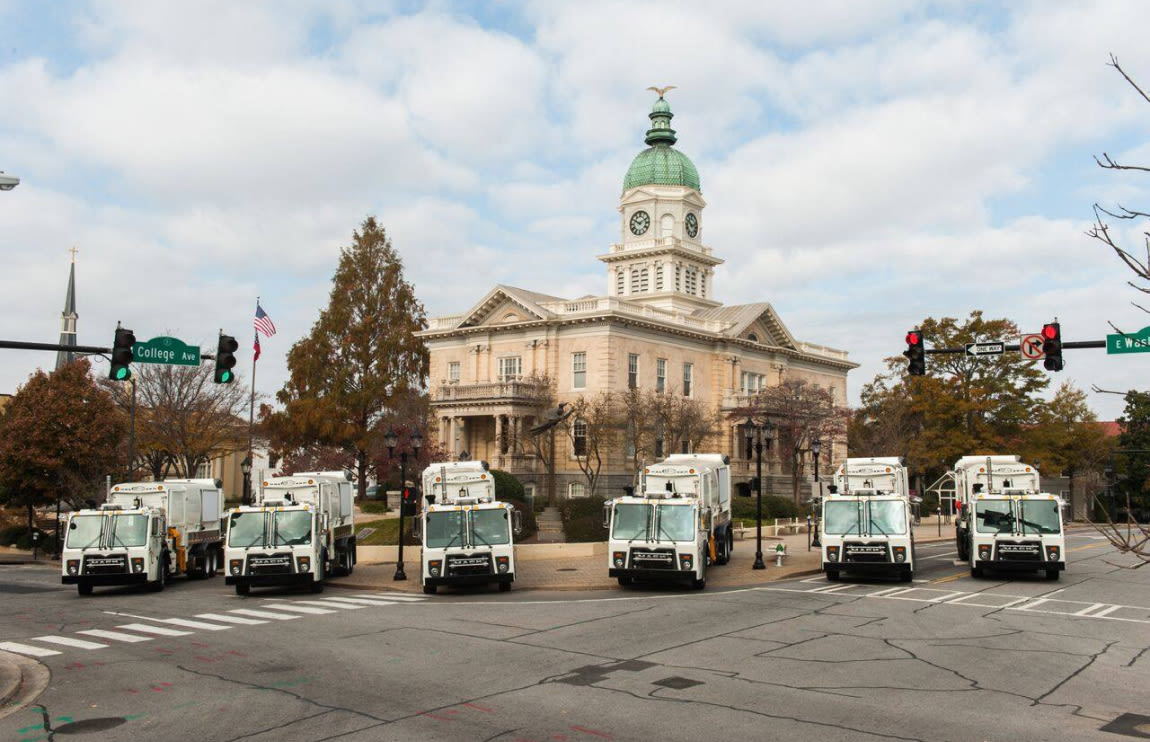
Better understand speeding trends with real-time data and automate paper handling using fleet telematics. Take a data-driven approach to safety by measuring vehicle diagnostic data and streamline file management by digitizing documents. Athens-Clarke County used fleet telematics to increase fuel efficiency by 58% and saved more than 12,400 sheets of paper.
Support EMS and emergency fleet safety with Samsara's AI Dash Cams and Connected Operations Platform, which support emergency vehicle operators during Code 3 responses and improve dispatch coordination, directly addressing FY2026's stronger emphasis on EMS and post-crash response.
If you’re interested in participating in the Safe Streets and Roads for All grant program and want to see how Samsara can help, you can learn more by checking out how government agencies improve citizen safety and transparency.
This blog was originally published on August 10, 2022. It was updated May 12, 2026.
Get the latest from Samsara
Subscribe nowRead more

Introducing Samsara MCP: your data, inside of your team’s AI tooling

VP, Product Management


– 8 min read
May product updates: New Samsara releases to help you improve efficiency

Director, Product Marketing


Celebrating the people who keep freight moving safely at Ontario’s All Routes Logistics

Sr. Content Marketing Manager - Canada

Next-gen fleet safety: SOS alerts for workers and AI-powered coaching with Samsara

Director, Product Marketing