Company News, Safety, New Features
Samsara's new safety innovations help fleets see, understand, and act on risk
June 24, 2026

VP, Product Marketing
Get the latest from Samsara
Subscribe nowSince day one, safety has been at the core of Samsara's mission. For more than a decade, we've built AI-powered tools that help frontline teams stay safe, reduce risk, and get home at the end of every shift. That work is having real-world impact: Samsara customers have prevented 380,000 accidents over the past year with the help of our platform.
Today, we’re excited to announce what comes next—a new generation of safety innovations built to not just react to accidents after the fact, but to help organizations see, understand, and take action on risk. Together, these products deliver a complete view of risk to help reduce preventable accidents, lower insurance and liability exposure, and give every driver the support they deserve on every trip. Watch the video for a walk-through of these new products, then read on for more details about how they can help reduce risk across your operations.

Play Video
Expanding the ability to see risk with new AI Multicam features and detections
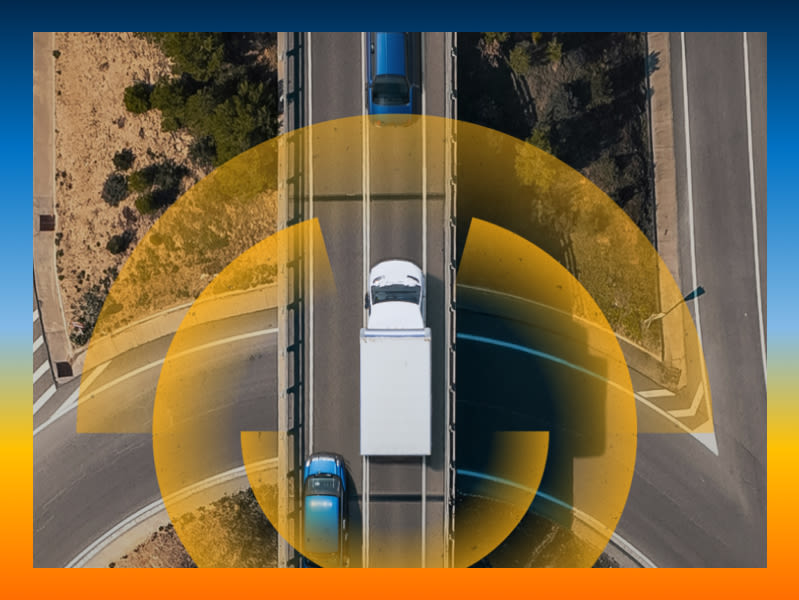
Detecting risk starts with the ability to see all of the hazards around you. That’s why we developed Samsara AI Multicam, an AI-powered multi-camera system that delivers 360° visibility around an entire vehicle. Today, we’re announcing a new set of AI detections that alert drivers to the hazards most likely to cause collisions in real time, before impact.
These include:
Rear Collision Warning: Identifies objects behind the vehicle during reverse—such as walls, poles, other vehicles—alerting drivers through escalating audio and visual overlays.
Vehicle in Blind Spot: Detects adjacent vehicles in a driver's blind spot when turn signals are active, warning drivers before a lane change becomes a collision.
Each detection also features AI-powered color-coding and audible alerts that inform drivers of potential hazards. Combined with Samsara’s existing Pedestrian Collision Warning, these detections arm safety teams with the critical visibility they need to keep drivers and the community safe.
Wireless Link
For drop-and-hook tractor-trailer fleets, getting reliable rear camera footage from the right trailer has long been a friction point. Alternative solutions require drivers to pair the correct trailer camera, adding steps that waste time and introduce confusion at the start of every trip. Wireless Link is a transmitter-receiver system that eliminates that friction entirely by automatically connecting to the right trailer camera, even in a crowded yard with multiple wireless signals nearby, without requiring any additional work from the driver.
Bird's Eye View
For fleets that often operate in narrow, crowded spaces—such as garbage trucks, transit buses, school buses, and delivery vehicles—individual camera feeds can only go so far. During docking, yard moves, and tight turns, drivers must consider multiple angles at once, creating cognitive overload precisely when full attention is needed. Bird's Eye View eliminates that burden by stitching camera feeds into a single real-time, top-down view of the space surrounding the vehicle, making hazard recognition intuitive rather than effortful.
Rear Collision Warning, Vehicle in Blind Spot, Wireless Link, and Bird's Eye View are available to customers for early access.
Extend visibility beyond the road with the 360 Camera
Complete visibility isn't just for on-the-road vehicles. The new 360 Camera is a single-mount, all-weather unit purpose-built for operator-controlled equipment, such as forklifts and pallet jacks, in warehouses, yards, and job sites. Because it captures every angle, you no longer have to predict where risk will come from or guess which direction matters most. By providing a complete 360-degree view of the operator's hands, feet, and surroundings, managers can use interactive pan and zoom features to get a clear picture of events from any angle. Configurable G-force impact detection automatically retrieves the video the moment a collision occurs, taking the guesswork out of non-road asset incidents and drastically cutting investigation time.
Alaska Airlines was among the first to bring the 360 Camera to their ramp operations. “With the 360 Camera, we extend safety to every type of ground service equipment on the ramp. Baggage tractors, tugs, pushbacks—each with its own unique demands and operating procedures,” said Mehdi Jnah, Director of Ground Support Equipment, Alaska Airlines. “Now we can see it all, respond in real time, and coach our teams with the context they need to operate safely. We believe this kind of innovation has the potential to transform ramp safety across the entire industry."
360 Camera is available now to select customers.
Understand and mitigate risk with Coaching Priority and AI-powered ride-alongs
Visibility is essential, but preventing accidents at scale demands the ability to continuously understand which drivers, routes, and behaviours represent the most risk. This is where many safety programs fall short. Even well-resourced teams struggle to move beyond reactive event review. This means the drivers who need support often don't get it until after something goes wrong.
Today, we’re adding powerful capabilities to enhance fleets’ ability to understand and mitigate risk, including:
Coaching Priority
For safety managers overseeing hundreds or thousands of drivers, the challenge isn't just knowing where to focus; it's identifying which drivers or behaviours need your attention before something goes wrong. Even one incident can have catastrophic consequences. In fact, analysis of Samsara data shows opportunities for targeted coaching are highly concentrated among a small group of drivers: The top 10% of high-risk drivers account for over 30% of crashes. That’s a small group making a significant impact on overall safety outcomes.
Coaching Priority is Samsara’s proprietary framework for surfacing and prioritizing coaching opportunities across your fleet, and the only solution of its kind available today. Coaching Priority continuously evaluates 45+ risk factors, including driver tenure, specific behavioural patterns, road conditions, and prior coaching history, and benchmarks your fleet against real-world crash data from the Samsara Network. Capturing information across 25 trillion data points and 100 billion miles driven annually, the network provides a scale that gives our AI unmatched accuracy in identifying the specific patterns that may lead to preventable incidents.
All these complex signals are consolidated into a single, actionable view, pinpointing where coaching attention should be focused in your organization. Coaching Priority highlights your fleet's top opportunities for improvement and shows how they're trending over time. Managers can see which drivers, teams, or tags contribute most to the fleet's overall risk exposure, and drill into individual profiles to understand the exact root causes that need attention. They can be more efficient by focusing coaching resources where they will make the most impact, while drivers know exactly which behaviours they can address to be safer.
AI-powered ride-alongs
The ability to automate ride-alongs solves some of the most persistent challenges that in-person observation can present. Traditional ride-alongs are incredibly time-consuming, which makes them nearly impossible to scale while providing consistent feedback to every driver. To make matters worse, many drivers don’t receive ride-along evaluations. In fact, a recent poll of Samsara’s Driver Council found that 45% of drivers have never had one. Moreover, when drivers do have a ride-along, they may alter their behaviour, which impacts the usefulness of the evaluation.
Now companies can conduct ride-alongs powered by AI, which changes this dynamic. They get a continuous view of how each driver actually operates over time at a scale that’s difficult to achieve with manual, in-person manager evaluations. Moreover, the solution reveals behavioural trends and risk patterns that managers may miss during event-based reviews, such as checking mirrors before lane changes, or driving with one hand on the wheel.
This capability observes drivers at regular intervals and assesses their risk against our proprietary 22-factor standard, the Samsara Safety Assessment Standard™. This standard is grounded in extensive federal crash research and is built to clearly surface risky behaviours before an incident occurs. It preempts risk by evaluating drivers on a granular level—for example, how frequently they're checking their mirrors—to spot precursors that could lead to a serious incident.
Customers receive an objective performance report for every driver that creates a genuine understanding of driver risk. They can be configured to run at different frequencies for various types of drivers. For example, the AI-powered ride-along can be set to run for all new drivers at 30, 60, and 90 days during their onboarding. Or, in another example, it can run twice a year for more experienced drivers. This is especially helpful for new drivers. We know from looking at data within the Samsara platform that the first 100 days are the riskiest for this group, and automating ride-alongs are a valuable way to help with onboarding.
Coaching Priority is available now and the ability to conduct AI-powered ride-alongs is available to try.
Act on risk with a fully reimagined driver experience
Today, we’re introducing a number of new capabilities to fundamentally reimagine the in-cab experience. These advancements change the dash cam from a passive device into an active, AI-powered two-way communication system to create a new “day in the life” driver experience that supports drivers from the start of every shift to the end of every week.
Paired with the Samsara Driver App, these features use existing Samsara camera technology to help build safer habits, deepen engagement, and help fleets retain the people they've invested in. Here’s how these advancements are changing the typical day in the life of a driver:
Beginning the shift
Before a driver pulls out of the yard, the experience is already working:
Hands-free driver assignment: When an unassigned driver is detected, drivers identify themselves by stating their name, which instantly assigns their vehicle, route, and driver profile—no manual manager input required.
Start-of-shift briefing: A personalized 30-second AI audio briefing sets the tone for the shift, covering safety behaviours to focus on, recent improvements, milestones achieved, and route context. It recognizes driver achievements in a positive tone while delivering effective coaching for the day ahead.
Briefings can be customized to make them relevant to certain driver groups across your fleet. Moreover, managers can configure briefings to focus on a specific set of information. For example, a fleet can push out HOS reminders and weather alerts in addition to information about safety behaviours and milestones. Drivers can also ask the briefing clarifying questions for more information on what's being communicated.
Competitions and rewards: Drivers check their performance in fleet-wide safety competitions—like anti-idling challenges, or peer-based leagues—directly in the Driver App. Real-time leaderboards and story-style recaps highlight rankings, achievements, and rewards at the start or end of each shift, helping keep drivers motivated and focused on safe driving.
On the road
Once moving, the experience continues across every mile of the route:
Commercial Navigation now with left-turn risk avoidance: Left turns account for 60% of intersection crashes. With Commercial Navigation, drivers get turn-by-turn routing via Apple CarPlay or Android Auto that proactively guides them around known high-risk left turns. The safest path is built into directions from the start, not flagged at the last second.
Manager-to-driver communication: Managers can initiate two-way voice calls directly through the dash cam at any point in the shift, supporting quick incident response, mid-route adjustments, and direct support without relying on hand-held phones or radios.
Driver-to-manager messaging: A button press on the dash cam lets drivers send a voice-to-text message to the manager (for example, "Send my manager a message that I’m running behind and will call when I’m off the road"), enabling fast resolution of issues without distraction.
AI answers to driver questions en route: Drivers can ask open-ended questions en route about aspects of a trip, such as route conditions or general information to an AI-powered agent that provides a hands-free resource throughout the shift. For example, “Can you let me know where the nearest gas station and rest stop is?”
Geofence notifications: When drivers enter a geofenced area, an AI-voice notification plays through the Dash Cam to notify them about important information they should keep in mind in that specific area. For example, if a driver crosses a geofence around a dense urban area, an alert can notify them of lower speeding limits or parking hazards.
End of shift and beyond
The engagement continues after the wheels stop:
Automated Recognition: Drivers receive timely recognition in the Samsara Driver App for safe driving milestones, performance improvements, and positive behaviours. Personalized highlights and achievements reinforce strong habits and keep drivers engaged throughout the day with automated recognition in the Driver App, with no additional admin effort required.
Next-gen messaging: Enhanced direct and group messaging gives teams a structured channel for daily communication that can include updates, safety content, incident documentation, and load securement photos with support for rich media, replies, reactions, and admin controls. Managers can use it to deliver operational updates that go beyond basic broadcasts and ask drivers to acknowledge them.
Weekly driving recap: AI powers a virtual coach that delivers personalized, automated weekly driving recaps that cover positives and constructive areas of improvement, which support continuous learning and engagement. The appearance and voice of the virtual coach can be customized to use particular people, for example, a manager or other familiar face within an organization, to help coaching resonate with drivers even more effectively.
Positive recognition, like kudos, safe driving streaks, and milestone acknowledgments, run through every touchpoint in this experience. That consistency is what transforms a safety program from something drivers tolerate into a culture they actively participate in.
The in-cab experience features are available to try today.
Learn more about how to reduce risk with Samsara
Every driver, on every trip, should have the visibility, intelligence, and support needed to stay safe. When AI gives safety managers the data to act before incidents happen—and gives drivers the consistent coaching and recognition they deserve—the results go far beyond accident reduction. They build a safety culture where drivers feel valued, managers operate with confidence, and fleets achieve measurably better outcomes on every journey.
For a closer look at our latest product announcements, join our quarterly product webinar or contact our team.
Get the latest from Samsara
Subscribe nowRead more

October product updates: 2 new Samsara releases to put every asset to work

Director, Product Marketing

Turn operational data into action with Samsara

Staff Product Marketing Manager, AI


Introducing Samsara MCP: your data, inside of your team’s AI tooling
VP, Product Management

September product updates: 4 new Samsara releases to close gaps in your operation
Director, Product Marketing

Announcing the 2026 Samsara Connected Operations Award winners

EVP, Chief Operating Officer - GTM

We built a new brand the way we build everything at Samsara — with you

EVP, Chief Marketing Officer

New innovations from Samsara help fleets find and recover the hidden operational costs
Director, Product Marketing

