The open platform imperative

How modern physical operations connect, scale, and lead with AI

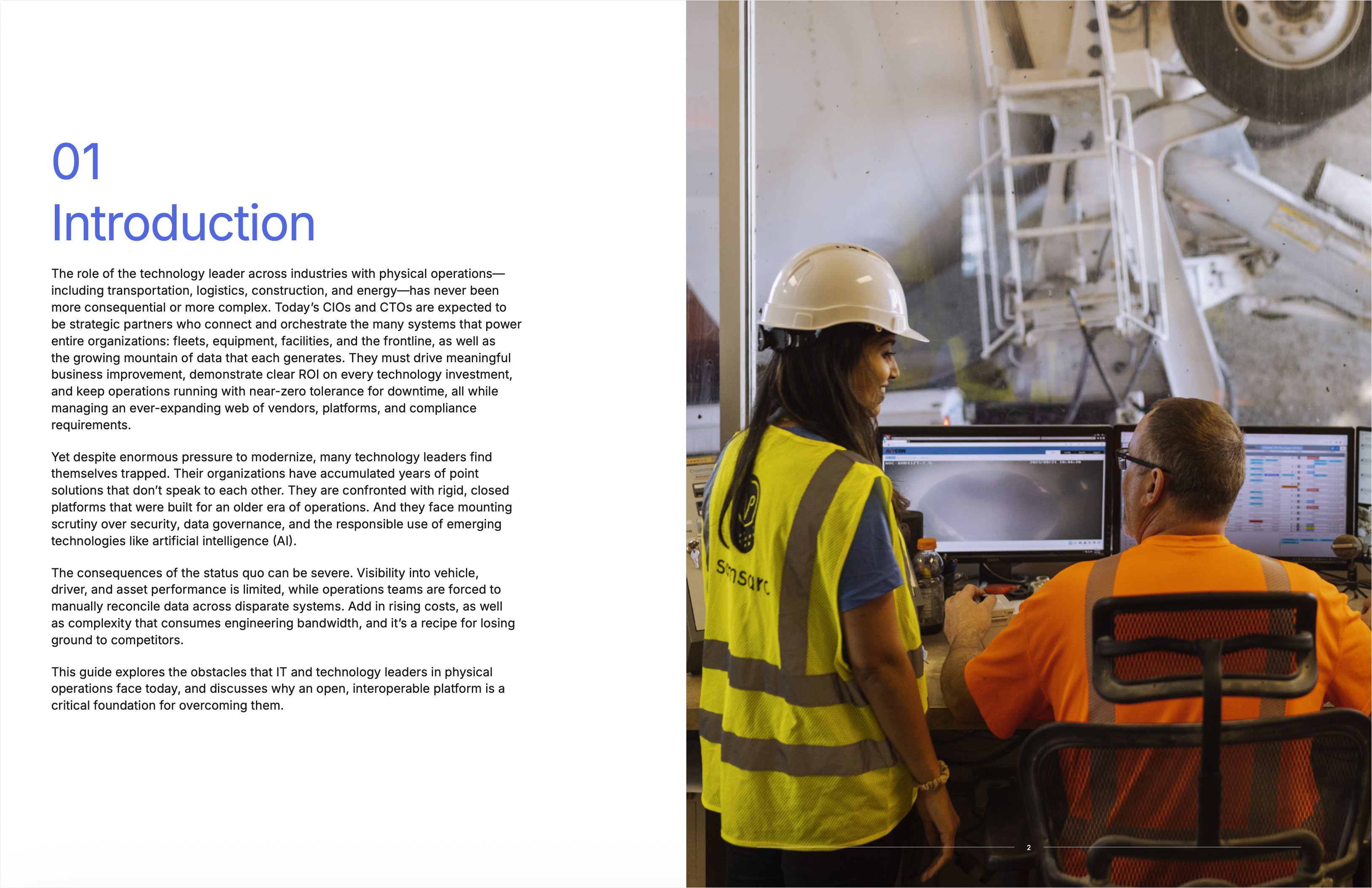
Today's CIOs and CTOs in transportation, logistics, construction, and energy are expected to do more than keep the lights on—they're strategic partners responsible for connecting fleets, equipment, facilities, and frontline teams into a coherent, data-driven operation. Doing that well, while also driving AI adoption, requires a data foundation built on an open, interoperable architecture.

This guide breaks down the top challenges IT leaders face in physical operations, and gives clear guidance on the benefits of an open, interoperable platform to help overcome them.

A preview of what’s inside

Get your guide

A must-read guide for CIOs, CTOs, and IT leaders driving modernization in physical operations

Many IT leaders are navigating fragmented systems, rigid platforms, increasing security demands, and rising total cost of ownership.

This guide, written specifically for technology leaders in industries with physical operations, makes the case for why an open, connected data platform isn't just a technology preference—it's a strategic imperative. Whether you're mid-migration away from legacy systems or evaluating your next platform investment, this guide gives you the framework to move forward with confidence.

Discover the six biggest barriers to IT modernization and guidance to overcome them

Download the full guide to understand how:

  • A unified data layer can eliminate fragmented systems and data silos: Understand why point-to-point integrations create compounding engineering debt, and how REST APIs, Webhooks, and Kafka-based streaming pipelines eliminate the problem at its root.
  • Developer-first architecture outperforms rigid, closed platforms: Learn why fixed workflows and limited APIs lead to vendor lock-in and technical debt, and what developer-first architecture looks like in practice with open SDKs, versioned APIs, and 350+ prebuilt integrations.
  • Enterprise-grade security capabilities protect your operations: Learn how advanced security standards—from AES-256 encryption and SOC 2 Type II to ISO 42001 AI governance—can protect a distributed, device-heavy environment without sacrificing flexibility.
  • A single platform reduces high total cost of ownership: See how consolidating onto a single operational data platform reduces direct licensing costs, eliminates custom integration overhead, and delivers measurable ROI at each stage of modernization.
  • A shared data foundation supports cross-functional alignment: Discover how a strong data foundation across your organization gives safety, finance, compliance, and operations teams access to the same ground truth—freeing IT from the data intermediary role and repositioning it as a strategic capability layer.
  • AI adoption can drive long-term benefits: Find out how clean, structured, consistently governed operational data makes AI initiatives actually deliver on their promise.

Get your free copy

If you're ready to move beyond fragmented architecture and build on a connected, enterprise-grade foundation, this guide will show you how. Download now for a practical, executive-level look at what an open platform makes possible—and how quickly you can get there.

Get your guide