Calculate your fleet's fuel savings potential
Fuel costs may be volatile. Your efficiency shouldn’t be.
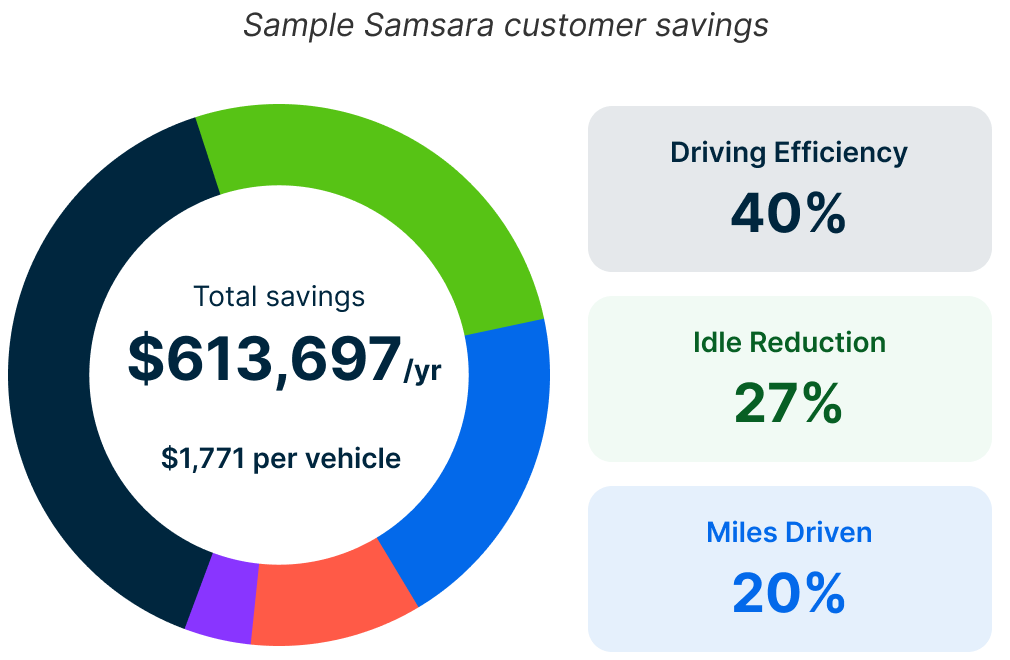
See how much you could save
How fleets improve fuel savings with Samsara
Identify hidden fuel costs
Compare vehicle performance to uncover where waste occurs.
Coach drivers for efficiency
Identify and coach drivers who idle or drive aggressively, reducing unnecessary fuel burn.
Prevent fuel theft and card misuse
Automatically flag suspicious transactions and sudden fuel drops.
Samsara Fuel <br> Spend Index
The Samsara Fuel Spend Index provides a weekly view of average U.S. diesel and gasoline customer spend, with national benchmarks, state-level analysis, and insights on how fuel costs are shifting.
See the Fuel Spend Index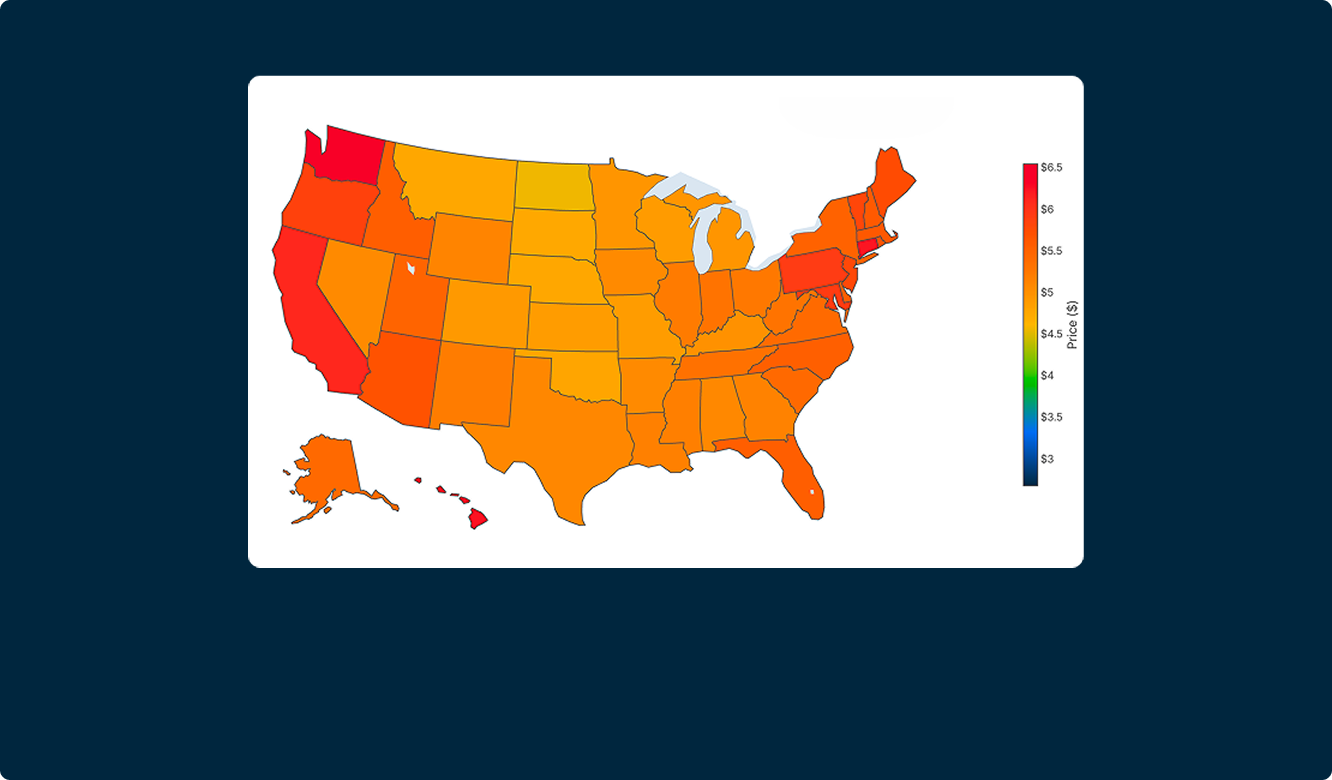
Samsara enabled Massey to save over 250,000 gallons of fuel in one year, translating to $1.3 million in fuel savings.

Fuel savings calculator FAQs
Fuel is one of the largest costs for fleets, and fuel price volatility recently has made it harder than ever to plan around. Over a recent six-month period, Samsara observed roughly $2 billion in avoidable fuel spend across its U.S. customers alone, a large percentage of this related to drivers simply fueling at the nearest station instead of the cheapest one.
For fleets looking to reduce fuel costs and protect their budgets from unpredictable fuel price swings, here are some actionable tips you can consider:
Benchmark fuel prices continuously, not quarterly: Track fuel prices against an external index rather than waiting for a scheduled P&L review, so a price move shows up in days, not a quarter later. Samsara's Fuel Spend Index benchmarks weekly diesel and gasoline prices from real fleet transactions across the U.S., broken out by state, with six years of history to compare against. The Fuel Spend Index refreshes fuel prices weekly across national and state levels so you have visibility into price changes, without needing to run your own research every time prices move.
Minimize fuel usage across your fleet: The less fuel a fleet burns overall, through idling reduction, efficient routing, and driver coaching, the less of the budget is at the mercy of price swings to begin with. Samsara's idling alerts, Commercial Navigation, and automated driver efficiency coaching are the specific levers that shrink that base without a fleet having to hunt down the waste manually first. You can calculate your fleet’s fuel savings potential with Samsara’s Fleet Fuel Savings Calculator.
Understand surcharge lag: Fuel surcharges tied to indices like the DOE weekly average typically can run behind the pump, and pass-through to end customers can take another four to eight weeks. Knowing this lag lets fleets plan cash flow around it instead of being caught by it. Samsara's Fuel Spend Index tracks the same weekly pricing data surcharge formulas are built on, so fleets can see the lag coming instead of reconstructing it after an invoice arrives.
Get real-time visibility into fuel spend: Tying every fuel transaction to vehicle and location data as it happens flags overspend immediately, rather than fleets discovering it during quarterly reconciliation, when it's too late to act. Samsara's Fuel Command Center ranks recoverable spend by category as it accumulates, not after the quarter closes.
Lock in lower average pricing: Routing to preferred, negotiated-rate vendors reduces the average price paid per gallon independent of where the broader market is headed. Samsara's Commercial Navigation automates this, building preferred-vendor fuel stops into the route itself rather than leaving the choice to driver discretion.
Fuel price benchmarking is comparing what a fleet actually pays per gallon against a reference standard, such as a national average, a state-level average, or a historical trend, to see where it's overpaying. Samsara's Fuel Spend Index benchmarks weekly diesel and gasoline prices from real fleet transactions across the U.S., broken out by state, with six years of history to compare against. This enables fleets to see which states are tracking above or below the national average and how their regional costs have shifted over time.
Fleet fuel management software integrates vehicle telematics with fuel purchase data to give fleets real-time visibility into fuel spend. Fleet fuel management software provides teams with full visibility into idling, inefficient driving, fuel fraud, fuel theft, IFTA compliance errors, and more.
Samsara offers an advanced fuel management solution that enables fleets to move from fuel visibility to fuel action automatically, without adding to the fleet team's workload. Some features that Samsara offers include:
A fuel spend command center that ranks recoverable spend by category (idling, inefficient driving, fraud, fueling location) so fleet managers know what to fix first, instead of a flat report of total spend
Driver efficiency scoring and coaching, often using a model that scores drivers against top-performing peers in similar conditions and automatically routes the least efficient drivers into coaching
Fuel card integration for purchase-level spend controls (limits, fraud rules) by driver or vehicle
Fuel theft and fraud detection that cross-references GPS location and vehicle activity against transactions and fuel-level data
Commercial (route) navigation that directs drivers to the lowest-cost, preferred fuel vendors along their actual route
IFTA and fuel tax compliance automation that captures mileage by jurisdiction from vehicle data and pairs it with fuel purchases for ready-to-file reports
Fuel price benchmarking against national and state-level indices to contextualize what the fleet is paying
Customers like Estes leveraged Samsara Fleet Telematics to gain immediate visibility into idling data, allowing them to take actionable steps from day one. By tracking idle events and coaching drivers accordingly, Estes saved over $3 million in fuel costs.
Fuel management software like Samsara enables fleets to reduce fuel cost by making fuel waste visible and giving fleet managers tools to act on it. Some features that Samsara’s fuel management solution provides include:
Route drivers to preferred or lower-cost stations using real-time prices and negotiated vendor rates, rather than letting convenience dictate every stop.
Build fuel stops into routes before departure and reroute when fuel is low, reducing detours, out-of-policy purchases, and unnecessary miles.
Identify unproductive idling and trigger in-cab alerts or coaching so waste is addressed while it can still change behavior.
Benchmark driver efficiency in comparable conditions to identify who has the greatest improvement opportunity, then automate targeted coaching and recognition.
Match fuel card activity with vehicle location and fuel-level data to flag suspicious drops or purchases.
Apply controls, such as limits and purchase requirements, to block inappropriate transactions before they clear.
A centralized dashboard can quantify recoverable spend across idling, fueling location, driver behavior, and suspected fraud—then rank opportunities by dollar impact.
Automated fuel-tax reporting and accurate trip/fuel data can reduce manual reconciliation and help teams file IFTA reports more accurately.
Many customers have leveraged Samsara to reduce fuel costs and maximize fuel efficiency, including:
Mohawk Industries: Reduced idling by 12% saving $600,000 in fuel costs, reduced miles driven by 4.2M saving $7.75M through improved routing, completed a one-time routing audit saving $650,000 in component pay and driver overpayments, removed 200 trailers saving $500,000 annually, cut communication time by 93%, and reduced administrative work by 75% across a fleet running over one million miles every week.
Massey Services: Massey had limited visibility into vehicle activity and had challenges with excessive idling—especially in the hot Southeast climate where air conditioning is necessary for driver safety. With Samsara, Massey transformed their fuel management, using idling alerts to manage fuel usage and the Wex integration to centralize fuel reporting. Visibility due to AI Dash Cams also helped to reduce unauthorized vehicle use. Altogether, Samsara enabled Massey to save over 250,000 gallons of fuel in one year, translating to $1.3 million in fuel savings.
Gordon Food Service: Reduced idling from as high as 17% to under 2%, saved 700,000 gallons of fuel translating to $2.5M in total fuel spend savings, and eliminated days of potential trailer downtime across 10,500 vehicles and trailers making 17,000 daily deliveries to 113,000 customers.
ITF Group: Improved fuel efficiency from 6 MPG to up to 7.5 MPG, reduced idle time to 29%, achieved a 25% improvement in routing optimization, saved $4M in fuel costs, and generated $8.4M in combined fuel and insurance savings across 2,000 trucks and trailers serving customers in food and beverage, retail, and e-commerce.
Estes: Saved $3M in estimated fuel costs and achieved a 40% increase in ETA predictability using the Samsara Platform across a fleet of 10,400 tractors and 40,000+ trailers for the fourth largest LTL carrier in the United States.
Summit Materials: Saved $1.8M in fuel costs per year and decreased preventable safety incidents by 50% using Samsara Fuel Reports to track fuel usage in real time and reduce idle time across 400 sites, 4,000 vehicles, and 12 companies.
Liberty Energy: Expects to save $10M annually across their entire operation including fuel efficiency improvements across 3,200 heavy-duty trucks, 6,200 tracked assets, and 3,500 drivers using Samsara to gain complete visibility into their oilfield service operations.
R.E. Garrison Trucking: Saved $730,000 in fuel costs year over year, lowered preventable accidents by 30%, and reduced workers compensation claims by 83% across a fleet of 800 tractors and 1,500 refrigerated trailers hauling food products across the Southeastern and Midwestern United States.
Michigan State University: Reduced idling by 71% saving $60,000 annually, achieved a 30% increase in hours between PM cycles, and protected $1M+ in assets across 5,000 acres and 16 satellite locations.
City of El Paso: Achieved a 24% decrease in idling saving approximately $100,000 annually in fuel costs, reduced an estimated 680,000 pounds of CO2 emissions per year, reduced mobile usage events by 80%, reduced accidents by 29%, and saved $145,000 in accident-related costs across their environmental services department managing waste collection for 800,000+ residents.
City of Fort Lauderdale: Reduced idling by 20%, saved approximately $70,500 in fuel over just six months, and reduced vehicle downtime by 28% across 1,700 vehicles and 11 city departments.
Hope Gas: Achieved a 20% decrease in excessive idling, reduced catastrophic vehicle failures and the associated downtime and replacement costs by an estimated 12%, and recovered a stolen side-by-side valued at $40,000 across natural gas operations serving 125,000 customers in West Virginia.
Ferrellgas: Improved driver efficiency scores by 33% using idling reports, saved 10% on fuel in the first year, and consolidated five separate communication channels into one using the Samsara Driver App across a fleet of 4,000 vehicles delivering propane across all 50 states and Puerto Rico.
UniGroup: Reduced idling by 5% as part of a newly launched efficiency program and cut fuel purchase data processing time by 95% using Samsara's open API across a fleet of 3,500 vehicles and 4,700 drivers.
Kreilkamp Trucking: Saved 187,000+ gallons of fuel compared to the annual industry average, reduced tardy deliveries by 15%, decreased preventable incidents by 60%, and decreased driver turnover by 20% in one year using AI Dash Cams, proactive driver coaching, and idling reports across a fleet of 300+ drivers, 375+ vehicles, and 1,030+ trailers.
Crafty: Achieved a 4% improvement in fuel usage in just three months and reached the top 10% for fuel efficiency compared to peer organizations while improving Safety Scores by 5% and achieving a 33% year-over-year reduction in auto claims across 40 markets.
VLS Environmental Solutions: Reduced overall mileage by 8%, reduced total fuel consumption by 6% saving over $350,000 annually, extended vehicle operational life by 15%, reduced fleet-wide CO2 emissions by 10%, increased their alternative fuel fleet by 20% using Samsara's Electrification Report, and saved over $800,000 in annual auto claims across 500+ vehicles at 50+ locations.
Athens-Clarke County: Achieved a 55% increase in fuel efficiency, eliminated 12,000 pieces of paper monthly, and improved the safety and efficiency of their services across a mixed fleet of 40 vehicles serving 130,000 residents across 117 square miles.
Alterman: Saved 10% in fuel costs using the Samsara and Coast integration to achieve total fuel management across 400+ vehicles and 350+ drivers at 5 locations. Fleet Manager Christian Duarte stated, "With Samsara and Coast, we can be confident that our fuel management and costs are all aligned. Coast handles fuel spend, and Samsara ties in telematics. It's total fuel management."
All Aboard America: Used API integrations to discover their actual operating costs across 30M miles driven annually, increased revenue by 30% through amended pricing, reduced administrative workload by 20%, and saved $1.6M annually across 6 divisions and 1,000+ buses and drivers.
Certarus: Saved $500,000 in maintenance costs, saved 8,500 hours from digitized billing, and contributed to $100M+ in new contracted revenue by using Equipment Monitoring and Vehicle Gateways to track asset health and optimize delivery operations across compressed natural gas, renewable natural gas, and hydrogen delivery at 19 locations.
Maxim Crane Works: Saved approximately $13M in 2024, about $1M per month, through a predictive maintenance program that reduced unplanned downtime and unnecessary fuel consumption, reduced harsh driving events by 94%, speeding by 87%, and increased billing for excess equipment usage by 27% year over year across 60+ locations.
DeSilva Gates Construction: Leveraged Samsara Asset Tracking and Samsara Connected Workflows to save $2.34M annually by preventing equipment delays caused by paperwork inefficiencies and eliminated unnecessary vehicle movement and idle time.
City of Sacramento: Expects to save $300,000 annually in fuel costs, reduced fuel consumption by 6%, and saved 100+ hours in administrative work using Samsara Fleet Telematics and the Fleet Electrification Report across a fleet of 2,600 vehicles including 120+ EVs serving 528,000+ residents.
City of Boston: Achieved a 36% increase in electric miles driven, saved $86,000 in estimated fuel costs, and reduced carbon emissions by 513,000 pounds using Samsara's Fuel and Energy Report across 400 vehicles managed by their Public Works Department serving 700,000+ residents.
Werner Enterprises: Reduced harsh braking by 20% and harsh turns by 50% across a fleet driving three million miles every day, with improved driver behavior directly reducing the fuel waste associated with aggressive driving across 8,000 vehicles and 30,000 trailers.
Veritiv: Achieved a 32% reduction in emissions in 3 years using Samsara reports to track and reduce total miles driven and idle time across a fleet of 500+ trucks and 60+ U.S. distribution facilities as part of an ambitious goal to cut emissions in half by 2030.
Sobeys: Saved an estimated 4,600 gallons of diesel and 469 metric tons of carbon emissions in just four months using Smart Trailers and Utilization Reporting to optimize trailer deployment and avoid unnecessary vehicle purchases across 16,000+ stores and millions of cases shipped.
Telematics like Samsara detects fuel theft by providing visibility into every fuel transaction against GPS location and vehicle activity in real time, flagging purchases that don't match where a vehicle actually was, and alerting on fuel-level drops that don't correspond to normal usage. Some features that Samsara provides for fuel theft include:
Sudden fuel-level drop alerts: Configurable alerts trigger on a sudden fuel-level drop of 10% or more, a common signature of siphoning.
Vehicle-proximity fraud checks: Fraud detection compares vehicle location at the time of a card swipe against the fueling station's location, flagging transactions where the vehicle wasn't actually present — the exact scenario a card-only provider can't catch until a report is run weeks later.
Fuel-level rise detection: Configurable rules flag anomalous fuel-level increases as well as drops, catching improbable events (like a tank refilling itself) that indicate card misuse or data manipulation.
Point-of-purchase blocking: With fuel card integrations, a transaction simply won't authorize if the vehicle isn't at the pump — moving fraud prevention from after-the-fact detection to real-time blocking.
AI receipt capture for cash/non-card purchases: Automatically organizes and reconciles receipts for fuel bought outside the card system, closing a gap that's otherwise invisible to any fraud-detection system.
For example, Bramco used Samsara to gain greater fuel oversight and fraud prevention across a multi-state operation. By integrating its Comdata fuel program with Samsara across 17 branches, Bramco replaced static fuel reports with a live, data-driven dashboard. Proximity Fueling and tank capacity alerts help prevent theft and flag suspicious transactions automatically. The team can now analyze MPG by vehicle model to uncover performance gaps and coach accordingly.
Idling can significantly increase fuel costs by wasting fuel while a vehicle isn't moving. Across an entire fleet, excessive idling can add thousands of dollars in unnecessary fuel expenses each year while also increasing engine wear, maintenance costs, and greenhouse gas emissions. Fleet managers can reduce fuel costs by tracking idle time with GPS fleet management software, setting idle alerts, coaching drivers to minimize unnecessary idling, and using automated reports to identify vehicles with excessive idle times. By reducing idle time, organizations can reduce their carbon footprint, increase fuel economy, lower operating costs, and extend vehicle lifespan.
Samsara's Fuel Management solution uses context-aware idling alerts that factor in weather, PTO status, location, and temperature to distinguish necessary idling from waste, paired with in-cab audio reminders to correct behavior in the moment.
For example, Gordon Food Service used Samsara to reduce its nationwide idle rate from 17% to under 2%, saving 700,000 gallons of fuel and $2.5 million annually.
IFTA, the International Fuel Tax Agreement, requires interstate carriers to reconcile miles driven and fuel purchased across as many as 58 U.S. and Canadian jurisdictions, four times a year. Done by hand, that reconciliation depends on drivers' logs and fuel receipts being complete and accurate, and estimated (rather than measured) mileage and fuel figures are consistently one of the most common sources of filing errors. Fuel management software like Samsara supports IFTA reporting by automatically recording mileage by jurisdiction from the vehicle's engine/GPS data and pairing it with fuel purchase records to generate ready-to-file quarterly reports, replacing manual reconciliation across up to 58 taxing jurisdictions.
Some benefits of using Samsara for IFTA reporting include:
Automate the two inputs IFTA requires: IFTA requires inputs for miles driven per jurisdiction and fuel purchased per jurisdiction. Automatically capturing both from vehicle telemetry and card/receipt data removes the quarterly manual reconciliation most fleets otherwise do by hand.
Reduce audit exposure: When mileage and fuel records don't hold up under audit, auditors can apply penalty assumptions. For example, cutting a vehicle's reported MPG by 20% or assessing it at a flat 4.00 MPG inflates the tax owed regardless of what was actually consumed. With accurate, automatically captured jurisdiction-level data, you can avoid errors and ensure that your data holds up under IFTA audits.
Avoid late-filing penalties: Filing deadlines and penalty structures vary by base jurisdiction. For example, Michigan assesses a penalty of $50 or 10% of tax due, whichever is greater, for a late IFTA return. Automated reporting reduces the risk of missing a deadline due to manual reconciliation delays.
Free up back-office time: Quarterly filings get prepared from data the platform already has, rather than skilled back-office staff spending their time on reconciliation instead of cost control.
A fuel card is a specialized payment card designed for businesses to manage and control fuel purchases for their vehicles. Unlike regular credit cards, fleet fuel cards offer features such as spending controls, detailed transaction data, and integration with fleet management systems.
Fleet fuel cards can be used at a wide network of fueling stations, providing convenience and flexibility for drivers and mixed fleets. Additionally, many fleet fuel card programs offer access to discounts and rebates, helping businesses save money on their fuel expenses. Fuel cards offer many benefits such as:
Fuel savings: Fleet fuel cards deliver significant fuel savings through fuel rebates, fuel discounts, cash back, and optimized purchasing controls. By leveraging the negotiating power of fuel card providers, your business can access competitive pricing, reduce fuel costs, and save money on every gallon of fuel purchased.
Fraud prevention: Fleet fuel cards enhance fraud prevention by enabling spending controls, real-time alerts, purchase controls, and detailed transaction monitoring. You can set limits on purchase amounts, monitor employee spending, restrict transactions to specific merchants or fuel types, and receive instant notifications for suspicious activity. These features help mitigate the risk of unauthorized purchases and protect your business from financial losses.
Streamlined reporting: Fleet fuel cards come with powerful reporting tools that simplify administrative tasks and provide valuable insights. Streamlined reporting supports International Fuel Tax Agreement (IFTA) compliance by automatically capturing mileage and fuel purchase data, reducing manual effort and ensuring accuracy. Detailed expense tracking allows you to monitor fuel costs, identify trends, and make informed decisions based on real-time data.
Samsara offers a powerful fuel management solution that helps fleets cut costs, waste, and fraud. In addition, Samsara offers one of the largest ecosystems of turnkey integrations designed to connect seamlessly with essential third-party applications, including integrations for fuel cards. With seamless connectivity and real-time data across your organization’s most critical tools, you can break down data silos and improve operational efficiency. Samsara offers integrations with many fleet fuel card providers, including FLEETCOR, WEX Fuel Card, AtoB, Fleevo Fuel Analytics, Fleevo Fuel Card Connector, Relay Fuel, E.J. Ward (SimplyFuel Solutions), RoadFlex, Shell Fuel Card, Coast, Voyager, Allstar, Multi Service Fuel Card, SC Fuels, and more.
Customers like Alterman were able to unify their fleet tracking and fuel management by integrating Samsara and Coast. With this integration, Alterman gains real-time data, automated reconciliation, and improved receipt capture, unlocking an enhanced level of control across their fleet's fuel usage. As a result, Alterman is able to make smarter decisions across their fleet, helping them reduce fuel costs by 10%.
Route optimization helps fleets plan the most efficient routes for vehicles making deliveries or service stops based on various real-world constraints. By analyzing multiple factors such as traffic patterns, vehicle capacity, driver schedules, and more all in real time, fleets are able to automate the route planning process and determine the most cost-effective route for their delivery drivers. Route optimization reduces fuel costs by reducing the miles driven. Samsara helps fleets save fuel costs by automatically detecting when fuel drops below a set threshold and reroutes drivers to the nearest preferred vendor. Samsara also provides real-time pump prices and company-preferred vendor filters so every fueling decision saves money. Customers like Mohawk Industries improved its on-time customer service rate by 5 percentage points, to 97%, after adopting Samsara's routing platform, while also reducing miles driven by 25%, and real-time impact analysis shows planners how edits will affect service-window risk before they commit to a change.
Samsara offers the best fuel management solution in the industry. Samsara combines fuel card transactions with real-time GPS tracking in one unified platform, so fleet managers see fuel purchases alongside vehicle location, tank levels, and diagnostics. This makes it possible to catch inefficiencies like excessive idling and unauthorized fuel activity as they happen. Samsara offers an advanced fuel tracking system, enabling fleets to cut fuel costs, fuel waste, and fuel fraud. Samsara offers significant benefits, such as:
Buy fuel at the best price: Use fuel price overlays to coach drivers towards cost-saving fueling choices, such as preferred stations or in-yard fueling.
Minimize fuel waste: Improve fuel efficiency with weather-aware idling insights, driver alerts, and driver efficiency reporting.
Fleet benchmarks for fuel usage: Identify opportunities for improvement across key efficiency metrics by comparing against customizable peer groups. Use tags to create benchmarks for different groups within your organization.
Tackle theft and fraud: Prevent unauthorized fuel use with real-time theft alerts, vehicle proximity and fuel level rise detection, AI-powered receipt capture, and fuel card integrations.
Ensure compliance: Streamline IFTA reporting and compliance with Samsara's automated reporting. By reducing manual work, speeding up processes, and ensuring accuracy, you can save time and maximize tax savings with confidence.
Many organizations have used Samsara to reduce fuel costs and improve fuel efficiency. Some examples include:
Mohawk Industries: Reduced idling by 12% saving $600,000 in fuel costs, reduced miles driven by 4.2M saving $7.75M through improved routing, completed a one-time routing audit saving $650,000 in component pay and driver overpayments, removed 200 trailers saving $500,000 annually, cut communication time by 93%, and reduced administrative work by 75% across a fleet running over one million miles every week.
Massey Services: Massey had limited visibility into vehicle activity and had challenges with excessive idling—especially in the hot Southeast climate where air conditioning is necessary for driver safety. With Samsara, Massey transformed their fuel management, using idling alerts to manage fuel usage and the Wex integration to centralize fuel reporting. Visibility due to AI Dash Cams also helped to reduce unauthorized vehicle use. Altogether, Samsara enabled Massey to save over 250,000 gallons of fuel in one year, translating to $1.3 million in fuel savings.
Gordon Food Service: Reduced idling from as high as 17% to under 2%, saved 700,000 gallons of fuel translating to $2.5M in total fuel spend savings, and eliminated days of potential trailer downtime across 10,500 vehicles and trailers making 17,000 daily deliveries to 113,000 customers.
Alterman: Saved 10% in fuel costs using the Samsara and Coast integration to achieve total fuel management across 400+ vehicles and 350+ drivers at 5 locations. Fleet Manager Christian Duarte stated, "With Samsara and Coast, we can be confident that our fuel management and costs are all aligned. Coast handles fuel spend, and Samsara ties in telematics. It's total fuel management."
ITF Group: Improved fuel efficiency from 6 MPG to up to 7.5 MPG, reduced idle time to 29%, achieved a 25% improvement in routing optimization, saved $4M in fuel costs, and generated $8.4M in combined fuel and insurance savings across 2,000 trucks and trailers serving customers in food and beverage, retail, and e-commerce.
Estes: Saved $3M in estimated fuel costs and achieved a 40% increase in ETA predictability using the Samsara Platform across a fleet of 10,400 tractors and 40,000+ trailers for the fourth largest LTL carrier in the United States.
Summit Materials: Saved $1.8M in fuel costs per year and decreased preventable safety incidents by 50% using Samsara Fuel Reports to track fuel usage in real time and reduce idle time across 400 sites, 4,000 vehicles, and 12 companies.
Liberty Energy: Saved $10M annually across their entire operation including fuel efficiency improvements across 3,200 heavy-duty trucks, 6,200 tracked assets, and 3,500 drivers using Samsara to gain complete visibility into their oilfield service operations.