Perspectives
How Sobeys modernized national fleet maintenance and unlocked actionable insights with AI
August 25, 2026

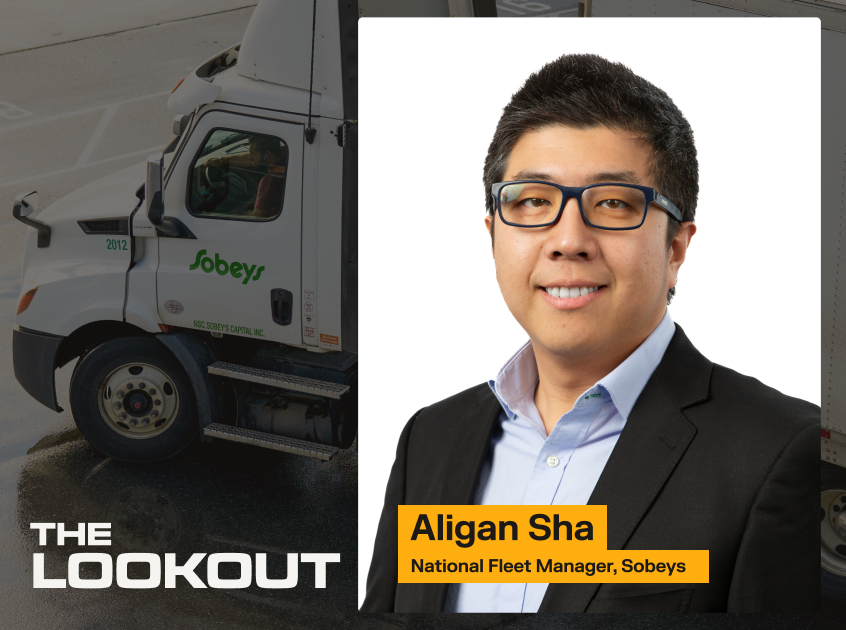
National Fleet Manager, Sobeys
Get the latest from Samsara
Subscribe nowGrocery retail doesn't stop. Stores open every morning whether or not the trucks showed up the night before, and that means the fleet runs 24/7—no quiet season, and very little room for error.
As the National Fleet Manager for Sobeys, I oversee one of Canada's largest private fleets: hundreds of tractors and thousands of trailers serving over 1,600 stores coast-to-coast, maintained through a network of in-house shops and third-party vendors across 23 Retail Support Centres (RSC). At that scale, maintenance isn't just an operational concern. It's a data problem. And for a long time, it was one we couldn't fully solve.
Over the past year, that has started to change. Here's what we did, what we learned, and where we're headed.
1. Let AI do the heavy lifting on invoices
The quality of your maintenance decisions is only as good as the data behind them. If you're relying on manual entry to capture repair details, you're building on an unstable foundation, regardless of which system you're using.
As we scaled our maintenance program nationally, the absence of vendor integrations created issues. Everything fell back on manual entry, and a five-page invoice with 15-plus labour lines could take an administrator 30 to 45 minutes to key in, with no guarantee of accuracy.
The invoices were being coded by administrative staff, not maintenance experts, and that gap showed up constantly in the data. Parts would get miscoded to the wrong VMRS groups—a hydrocarbon doser valve (also known as the 7th injector, an exhaust after-treatment part) coded to the engine system because someone saw the word "injector," or a fifth wheel coded under the wheel system instead of the coupling system. And then there were the one-liners: $2,500 worth of repair logged as a single line item with no description. That tells me nothing as a fleet manager.
The turning point was adopting AI-powered invoice scanning through Samsara's Maintenance solution. Rather than replacing one manual process with another, the AI scans the invoice, creates a work order, writes a repair summary, and matches parts and labour against our existing service tasks and catalog, flagging potential warranties along the way—and all in under two minutes. What that speed unlocked wasn't just efficiency; it was accuracy at a scale that manual entry could never achieve. That time is reinvested into running a better end-to-end maintenance operation and auditing the AI’s output.
Before rolling it out nationally, I ran a structured pilot across a range of sites and real-world conditions, which I'd recommend to anyone making a similar change. The most challenging conditions are where you learn the most, and that groundwork is what builds confidence across the organization.
2. Shift your team from data entry to data analysis
Solving the data capture problem is only half the equation. The more important question is: what does your team do with the time they get back? In my experience, the answer should be analysis, not more administration.
At Sobeys, that shift has been significant. Instead of keying invoices, our team is now focused on planning preventative maintenance, auditing for warranty opportunities, and closing the loop on every repair from the moment a driver flags a defect to the moment the invoice is resolved. That end-to-end visibility—across every asset, every region, in one platform—is something we simply didn't have before.
At RSCs with in-house shops, mechanics now capture the full labour and parts cost of every repair in real time, which means I'm finally seeing the true cost of maintaining each asset in the fleet. And because engine hours and odometer readings flow from Samsara telematics into the maintenance platform automatically, our preventative maintenance due list has never been more accurate. The result is a team that's managing the fleet, not just processing paperwork.
3. Start building toward Total Cost of Ownership
Once your data is clean and your team is focused on analysis, the next opportunity is using that data to inform decisions—not just about day-to-day repairs, but about your fleet as a whole. The framework I'd encourage any fleet manager to work toward is Total Cost of Ownership (TCO).
TCO combines two curves: ownership cost (depreciation), which drops steeply early then flattens, and operating cost (fuel, repairs, downtime), which starts low on a new vehicle and climbs sharply over time. Together they form a U-shape, and the bottom of that U is your optimal replacement point—a data-driven answer, not a guess based on age or mileage alone.
Historically, the biggest hurdle to calculating TCO is inaccurate data. You can centralize everything in one system, but if the underlying entries are wrong, your analysis will lead you to the wrong conclusions. Samsara's Maintenance solution helps to solve this: AI-powered scanning ensures data is accurate from the moment it's captured, and with in-house labour, vendor invoices, and telematics data all in one platform, that foundation is what makes meaningful TCO possible."
Within weeks of having centralized data, I'd already recovered $2,000 in vendor billing discrepancies I never would have caught before. We're now working with Samsara's product team to make these insights systematic: parts usage analysis to identify patterns in component spending, chronic repair reports to flag repeated failures, and a full TCO view that shows exactly where each asset sits on that replacement curve. Is it a vendor issue? A parts problem? A warranty claim we're missing? These are the questions we're building toward answering.
At Sobeys, we're not just digitizing repair activity. We're building the foundation for smarter decisions across the entire fleet, and we're only getting started.
Ready to take your operations to the next level? Schedule a demo to see how connected operations can drive real impact—or log in to unlock more value from your existing Samsara platform.
Get the latest from Samsara
Subscribe nowRead more

Using technology to improve compliance, equipment tracking, and safety across Western Canada

VP of Fleet Services, Freight North Group of Companies

How tappCONNECT is scaling safer, more efficient passenger transit

Chief Operating Officer, tappCONNECT

How Sunrise Farms’ Director of Fleet and Livehaul led digital transformation with a lean team

Director of Fleet and Livehaul, Sunrise Farms
Why thousands of companies in the retail industry choose Samsara

EVP, Chief Operating Officer - GTM

Canada’s most dangerous winter roads

Head of Insights

How American Iron & Metal strengthened their safety culture and reduced accidents by 85%

Manager Transportation Safety & Compliance, American Iron & Metal

Caron Transportation Systems’ Dieter Blank on why safety starts with smart tech

Sr. Director, Customer Marketing

Sterling Crane Canada on transitioning to proactive maintenance to overcome harsh conditions

Regional Maintenance Manager, Sterling Crane Canada

Women at the wheel: How tech unlocks new opportunities in Canadian trucking
Vice-président principal, EVO Transportation et évangéliste Samsara