Safety – 7 min read
Scale coaching and driver communications with an intelligent in-cab experience
April 17, 2026

Staff Product Marketing Manager
Get the latest from Samsara
Subscribe nowYour best safety manager knows every driver by name, picks up every call, and genuinely cares about each driver’s safety. But they are only one person, and your fleet has hundreds of drivers.
Safety events pile up. Coaching that needs to happen at 2am instead happens the next day. No matter how big your safety team is, they can’t monitor every cab and every shift.
Scale is the constraint. Samsara’s intelligent in-cab communication system closes that gap—going beyond two-way calling to transform the dash cam into an AI-powered coaching and support system that keeps every driver focused, recognized, and safe throughout their day.
Every driver deserves a copilot
The dash cam used to be unidirectional—capturing events for review after the fact and alerting drivers only after something went wrong. Samsara's in-cab communication changes that. Every driver gets tailored support throughout their day:
Before their first mile
On the road when risks appear
When something goes wrong
We’ve built a complete conversational ecosystem that connects drivers, managers, and AI to deliver support across the entire trip.
At the center of this experience is Samsara Coach, an AI-powered solution that detects, analyzes, and responds across the entire fleet simultaneously: a personalized start-of-shift briefing before the first mile and a real-time check-in when drowsiness sets in. And when a manager needs to connect directly with a driver, Samsara's intelligent in-cab communication system enables a live two-way call through the same dash cam. Together, that's what makes it feel like a copilot rather than a monitoring system: support that's proactive and personal, as ready to recognize a driver's improvement as it is to catch safety risks.
Sears Home Services runs a national fleet of repair technicians, and the challenge of keeping those drivers supported at scale is exactly the kind of problem Samsara Coach was built to solve. "Samsara Coach's two-way, in-cab AI voice coaching helps us support our national repair technicians at scale," said Rocco Speziale, Senior Director of Asset Protection.
What coaching at scale looks like in practice
With Samsara in-cab communication, drivers get personalized AI-led guidance before every shift and real-time AI assistance when risks emerge. Managers can also communicate with drivers. When that support scales, the business case follows: fewer incidents, better driver retention, and lower operational costs.
To see this in action, let's take a look at real customer examples of how Samsara in-cab communication works across a driver's entire day.
Start-of-day briefings: personalized for every driver, before every shift
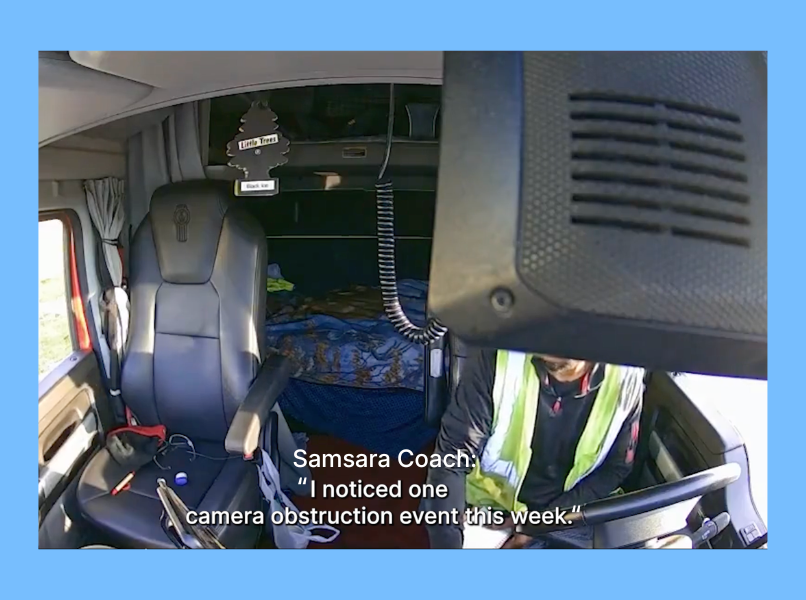
Before a driver turns the key, Samsara Coach has already prepared a personalized briefing for them—a capability no other fleet safety platform offers today. It recognizes recent improvements, flags behaviors to watch, and surfaces anything relevant to the route ahead. No manager phone call required.

Watch Video
In the video: A driver receives an in-cab audio briefing at the start of shift. Samsara Coach mentions that his camera position obstructs his face and requires adjustment. At the end of the briefing, the driver reaches up and repositions the camera—the coaching worked, in real time, before the route even started.
Two-way voice for drowsiness: support when it matters most
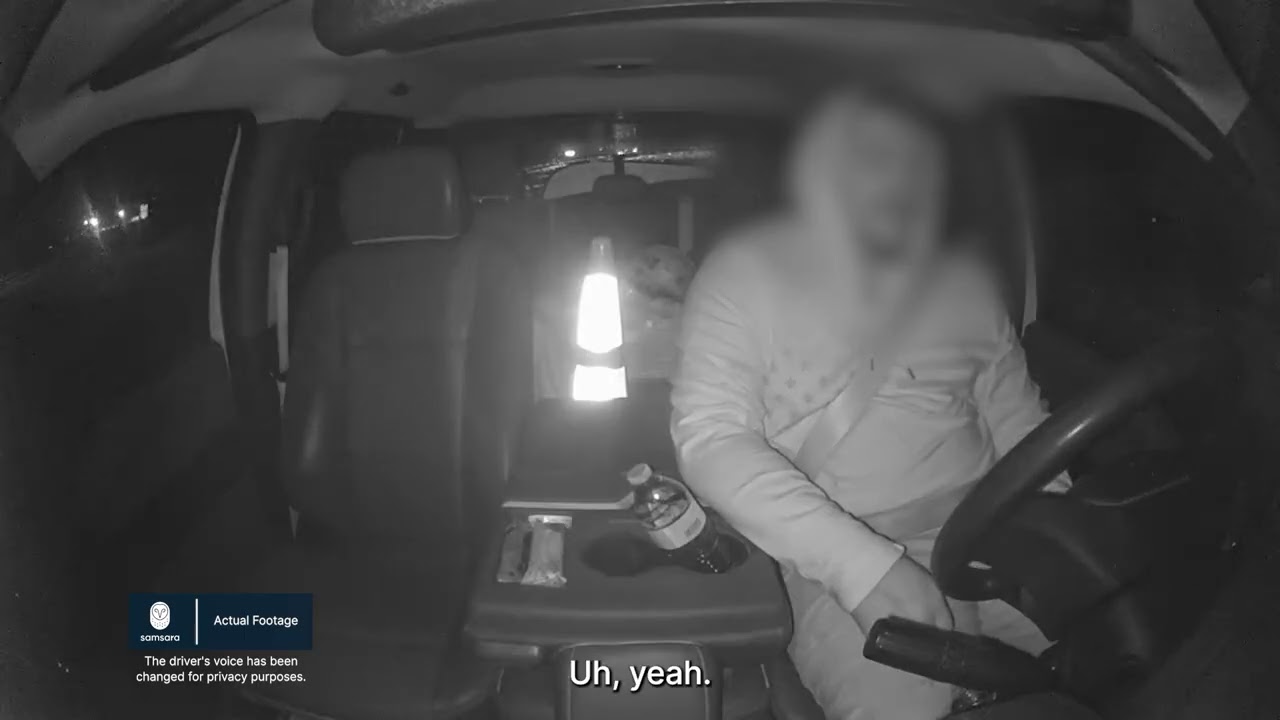
When a driver starts showing signs of drowsiness, Samsara Coach can respond by automatically initiating a two-way in-cab voice conversation to engage the driver at the moment the risk appears. No manager required for manual review.
Watch Video
In the video: A driver receives a two-way check-in from Samsara Coach after a drowsiness detection event. The driver responds, and the system guides the interaction—no manager involved, no delay.
Manager-to-driver check-in via dash cam: direct connection on-demand
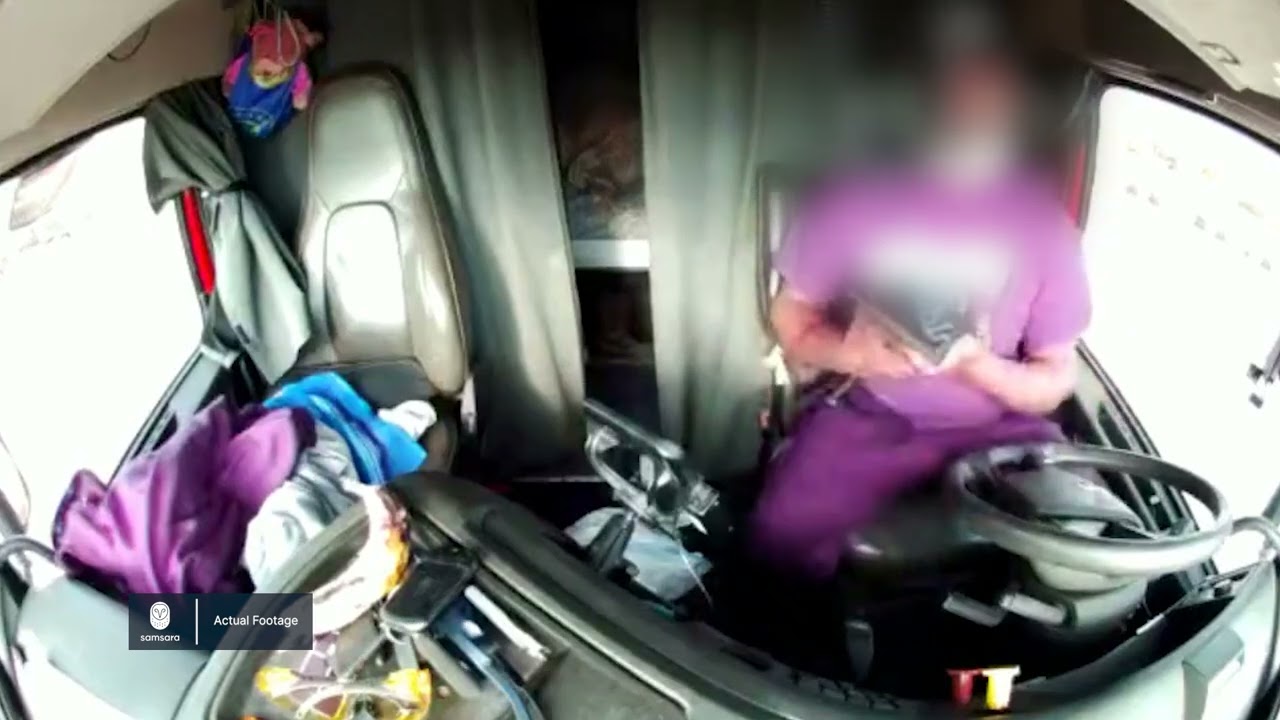
Samsara Coach handles the proactive, always-on moments—start-of-day briefings and drowsiness checks—at a scale no team can match manually. But Samsara in-cab communication also covers the moments that require a human voice. When something happens on the road, managers get an alert. Instead of trying to reach the driver by phone, the manager initiates a direct in-cab call through the dash cam. The driver gets the check-in. The manager gets confirmation. No phone tag. No missed calls. The same hardware already mounted in the cab handles the whole interaction—no new devices, no installation, no rip-and-replace.
Watch Video
In the video: Otis Anderson, a manager at Jordan Carriers, reaches out to a driver via dash cam after being unable to reach him by phone.
Jordan Carriers, a leader in flatbed trucking, uses in-cab manager-to-driver communication to reliably check in on drivers after an incident occurs. “We tried contacting a driver in his truck via phone but were unable to reach him,” says Otis Anderson of Jordan Carrier’s Safety Department, “I then used the dash camera to contact him and connected successfully. The driver mentioned that his phone lost battery. It’s this kind of technology that helps ensure our drivers stay safe and that we can instantly get them any help they need.”
These examples represent some of the most common moments where in-cab intelligence makes a difference. But the system goes further—soon, Samsara fleets will also deploy custom Samsara Agents for fleet-specific scenarios, from DOT inspection reminders to driver milestone recognition.
Delivering operational scale and a better driver experience
The efficiency wins are real, but the impact goes beyond the back office. Drivers who feel genuinely supported and recognized perform better and stay longer. In an industry where turnover is one of the highest operational costs a fleet faces, that's not a soft benefit. It also means safety managers spend less time fielding routine calls and more time on the work that actually needs them.
Two-way calling connects drivers and managers when a human voice is needed. Samsara Coach builds on that—AI that automatically coaches and supports, without a manager having to step in. Together, they create a true in-cab copilot running today on existing Samsara dash cams.
Contact your Samsara representative or request a demo to see these features in action.
Get the latest from Samsara
Subscribe nowRead more

Turn operational data into action with Samsara

Staff Product Marketing Manager, AI

Introducing Samsara MCP: your data, inside of your team’s AI tooling

VP, Product Management


– 5 min read
Introducing Samsara Competitions: Building driver engagement for safer habits

Principal Product Marketing Manager

August product updates: 5 new Samsara releases to help you turn insights into action

Director, Product Marketing

Built by you, for you: The new Samsara Community

Principal Community Manager

– 4 min read
Why safe routing is crucial after the SCOTUS broker ruling

Staff Product Marketing Manager


