Field Services
MacDonald-Miller Facility Solutions cuts vehicle repair time by 86%
With Samsara, MacDonald-Miller consolidated fleet operations to reduce costs, accelerate maintenance turnaround time, and improve safety and compliance.
Meet MacDonald-Miller Facility Solutions
1,500 EMPLOYEES
1,000 VEHICLES
The Challenge
Unreliable data and manual processes strained a lean fleet operation
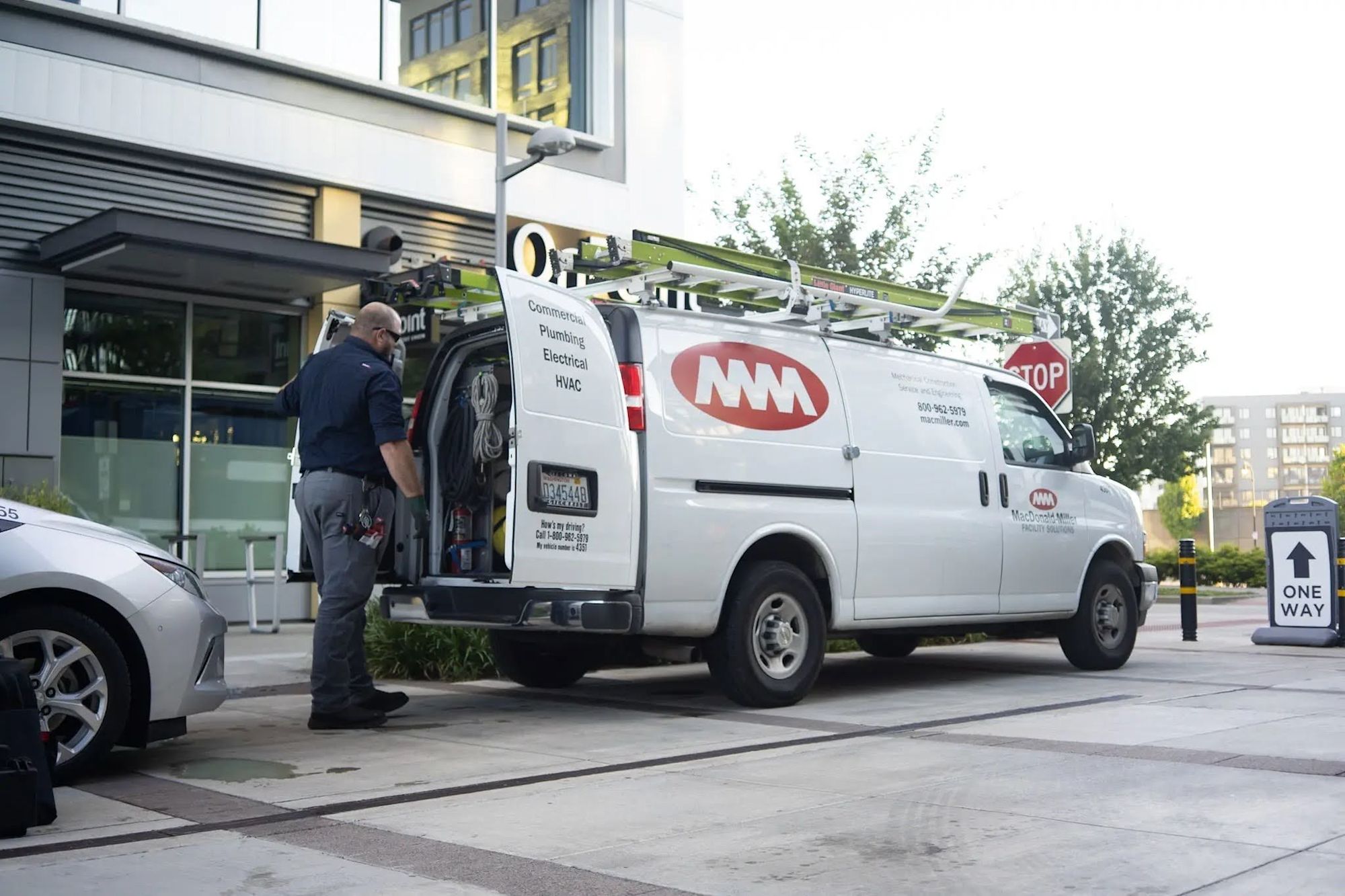
MacDonald-Miller Facility Solutions is a large commercial contractor operating across the Pacific Northwest. With more than 1,500 employees and a fleet of about 1,000 vehicles, fleet operations are managed by a small team, making efficiency and reliability critical to keeping everything moving.
Before switching from Verizon Connect, MacDonald-Miller dealt with unreliable telematics and fragmented processes. "We faced persistent OEM connection failures and slow support response times with Verizon Connect," said Meghan Marquardt, Fleet and Logistics Manager. As a result, GPS inaccuracies routinely misrepresented driver behavior, even placing vehicles on the wrong roads and triggering false violations. The lack of reliable data also left the team unable to confirm customer job site visits or effectively dispute claims. On the ground, operations relied on manual processes, including paper DVIRs that were easily lost and maintenance cycles could stretch up to seven days per vehicle.
"Samsara consolidated everything into a single platform, bringing multiple departments together while eliminating the cost of paying for separate tools and add-ons."
Meghan Marquardt
Fleet and Logistics Manager
The Solution
A rigorous pilot and OEM-first rollout enabled a smooth transition at scale
MacDonald-Miller ran a head-to-head evaluation of multiple providers, including Motive and Geotab, testing each one against criteria like tracking accuracy, API connectivity, EV support, and ease of use. Motive was eliminated early in the process. "When we asked Motive if certain capabilities existed, the answer was often 'not yet.' Because we had a strict scope for deployment, it quickly became clear they weren't the right fit for us," said Marquardt. The final decision came down to Samsara and Geotab, MacDonald-Miller selected Samsara for its strong API ecosystem, fast pace of product innovation, and a more practical, low-friction approach to sales and support.
For deployment, the team avoided a complex hardware installation by activating OEM telematics already built into most of their vehicles, enabling a fast, remote rollout across their distributed fleet. They introduced key workflows, including real-time tracking, safety scorecards, EV monitoring, and mobile DVIRs and ELDs. To manage change with a lean team, they used Samsara's self-guided training—directing employees to on-demand video resources and support tools—keeping the rollout efficient without adding administrative overhead.
The Results
Unified data, faster repairs, and real-time visibility transformed fleet efficiency
By consolidating onto a single platform, MacDonald-Miller reduced both software and hardware costs while eliminating the need to juggle multiple systems. What used to take up to 30 minutes of cross-referencing across tools can now be done in one place, giving teams a shared, reliable source of truth and significantly reducing administrative overhead. "Time is money. We no longer have to review different platforms to get the same answer. Samsara is a one-stop shop," said Marquardt.
In the field, real-time visibility translated into meaningful time savings. Dispatchers and zone drivers can instantly locate technicians without back-and-forth calls, and runners no longer waste time searching for vehicles across large lots, saving up to an hour per day. "Small time savings here and there quickly add up. Our drivers can get an hour back each day with Samsara. That's huge," said Marquardt. Digitizing DVIRs and capturing live fault codes also enabled a shift to proactive maintenance, cutting repair turnaround times by 86%, from a week to a single day.
The improvements extended to safety, compliance, and customer trust. Driver behavior metrics improved immediately, while the move away from paper logs helped the company achieve zero DOT infractions over a six-month period. With accurate, time-stamped GPS data, the team can now confidently resolve billing disputes and verify job site activity. At the same time, detailed idling and usage data is helping guide their transition toward an emissions-free fleet by 2040. "Idling data helps us decide which drivers are good candidates for an EV—someone who has higher idle times is a great candidate to make the switch. That helps us cut emissions and accelerate electrification at the same time," said Marquardt.
Ready to team up?
We're ready when you are. Let's talk about what your operation needs.
Check our prices