Efficiency, Perspectives
“The best mechanics choose the best tools”: Inside Samsara Connected Maintenance
March 25, 2026

Senior Product Marketing Manager
Get the latest from Samsara
Subscribe nowExecutive brief
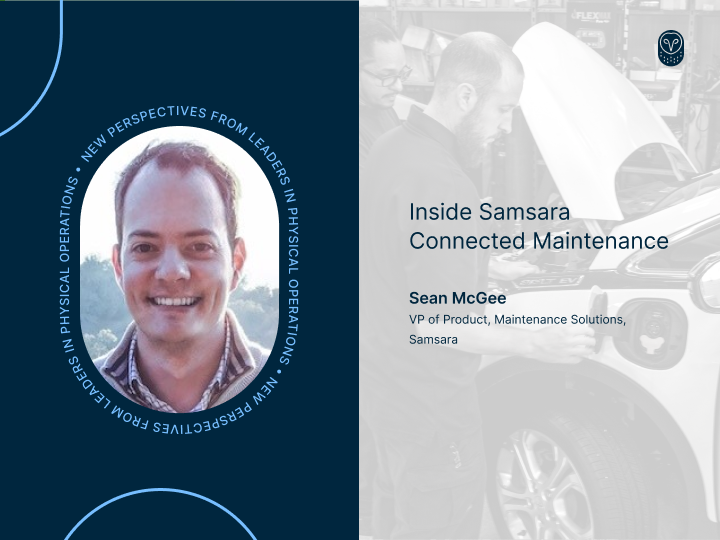
Sean McGee has spent eight years at Samsara building products that solve real operational problems—first in telematics, then on Samsara's platform layer, and now as the leader of Samsara Connected Maintenance.
I sat down with him to understand what drew him to one of fleet operations' most complex and underserved domains—maintenance—and where he believes the industry is headed.
Why maintenance — and why now?
To start, why maintenance — and why now?
For me, it was about finding the next big area where there's real pain and a clear path for impact. We started with fault codes and DVIRs, but the full life of the maintenance operation—scheduling, prioritization, in-house versus outsourcing, total cost of ownership—was still wide open.
And once you get into a shop and start talking to the people who run these operations, you see what’s needed pretty quickly. There's a lot of pain, but there's also a lot of clarity about what a better world looks like. That's a good place to build.
Boots on the ground: learnings from the field
What were your first impressions as you got to talk to maintenance professionals when you got into the field?
They are incredibly knowledgeable—and I mean at every level. When you sit down with a technician and talk through how they approach a problem, there is a tremendous amount of knowledge that comes from years and years of experience in the field. And that goes all the way up the ladder. Even the most senior people in the function know the ins and outs of how their department runs at a really detailed level. That was genuinely impressive to see.
And it shapes how we think about building the product. Our goal is to amplify that expertise and help people focus on the part of their job where they can really make a difference: fixing things. Most people got into maintenance because they love working on equipment. So the job of the software is to get out of their way: reduce the administrative burden and let them spend their time doing what they're actually great at.
What are the top pain points you hear consistently from maintenance teams?
Three things come up in almost every conversation.
The first is just basic visibility. Even something as simple as having a single place to see what's being worked on, what's been spent, and what's coming due—that doesn't exist for most organizations. That should be table stakes.
The second is administrative overhead. At every layer of the organization (technicians, leads, shop managers), people are spending half of their time on paperwork and manual tasks. That's not what they signed up for, and it's not where their value is. We want to give that time back.
The third is vendor and warranty management. Invoices are inconsistent. Warranty opportunities go uncaptured. This is exacerbated when fleet maintenance happens outside the shop, with third-party vendors. That work often gets much less oversight than in-house repairs, which compounds the problem. There's real money being left on the table, and our customers know it.
You described three pretty distinct pain points. When you look at those together, what do they tell you about what a maintenance platform actually needs to be?
They tell you that a maintenance platform can't just solve one slice of the problem. What's been really interesting to me coming into this role is just how deeply connected the maintenance function actually is. On one end, you have OEMs—vehicles coming in, warranties, everything associated with them. Drivers play a critical role, too; they're a huge part of surfacing what maintenance actually needs. And then there's all the in-house work, plus sourcing third-party repair vendors, which accounts for a significant share of what most fleets do. This is a deeply embedded ecosystem, and everything has to interoperate really well for it to be successful.
I actually think about it like an orchestra—each of these different parts has a role to play, and the platform has to be what holds it all together.
What does that mean practically, in terms of integrations and workflows?
Three things: integrations, automations, and analytics. Integrating into financial systems and ERPs. Automating things like PO generation so it happens without anyone having to trigger it manually. And analytics that surface the insights leaders actually need—where are we overspending with a particular vendor? Where are we leaving warranty money on the table?
That combination is what takes maintenance from an operational necessity to a strategic advantage.
Reimagining Computerized Maintenance Management Systems, Sean’s vision explained
How does Samsara's approach to maintenance differ from what's already out there?
A few things. We built a modern maintenance system from the ground up, which means we can be truly AI-native from day one—not bolting AI onto a system designed ten years ago. That changes what's actually possible.
Take invoice processing. Scanning and reconciling tens of thousands of invoices from third-party vendors was a genuinely hard problem five years ago. Today, AI handles it at scale, with high accuracy. Problems like that are exactly where AI is uniquely suited, and we're designing our entire product around that reality.
The other thing is that we're building this with some of the best maintenance experts in the industry. They're bringing decades of experience to the table, and they're designing the tool they always wished they'd had. That's a different starting point than most.
You mentioned AI-native design. Are maintenance professionals actually ready to embrace that?
More than ready. They're hungry for it. That was one of the most pleasant surprises for me.
We recently launched the ability for a technician to complete an entire work order through a two-way voice conversation with an AI agent. No typing, no tapping on a screen with greasy hands—just talking. When we brought that into shops and put it in technicians' hands, the reaction was immediate. People lit up. They're really excited about the opportunity for technology. That kind of moment tells you the demand is really there.
And there's another dimension to this: talent retention. Senior technicians are a hot commodity. They're expensive to recruit and expensive to lose. The best mechanics are going to want the best tools. Some of our customers have explicitly said they want to be known as the best place for a technician to work. That includes the quality of the tools. Technology isn't just an efficiency play. It's a culture play.
Where does this go in three to five years? What's the bigger vision?
Beyond maintenance, there's a much larger opportunity around total asset lifecycle management. Maintenance is one piece of how an organization manages its assets—but the bigger question is: how do you make smart decisions across the entire life of an asset?
When does it make sense to move an asset from a demanding route to a lighter one based on its wear profile? When does it make more financial sense to retire a piece of equipment than to keep repairing it? Our most sophisticated customers are already trying to answer these questions, often manually, off-platform. We want to bring that intelligence into the software.
And the definition of "asset" keeps expanding. We're already working with customers who want to manage not just trucks and trailers, but forklifts, yard equipment, garage doors and facility systems, and anything that requires regular attention and oversight. The platform we're building is flexible enough to handle it all.
If your team is still managing maintenance with pen and paper or spreadsheets, there's a better way. Learn more about Samsara Connected Maintenance.
Get the latest from Samsara
Subscribe nowRead more

Ferrellgas' Logistics Director on earning driver buy-in before the rollout, not after

Director of Logistics, Ferrellgas

Turn operational data into action with Samsara

Staff Product Marketing Manager, AI

Ace Tree Enterprise's Fleet Manager on staying emergency-ready while keeping daily operations moving

Fleet Manager, Ace Tree Enterprise

Brenntag’s Supply Chain Manager on working backward to find the solution you're really after

Supply Chain Manager, Brenntag North America

Glazer's safety leader on what it takes to keep a safety culture thriving five years in

Safety Engineering Manager, Glazer's Beer & Beverage

Introducing Samsara MCP: your data, inside of your team’s AI tooling

VP, Product Management

September product updates: 4 new Samsara releases to close gaps in your operation

Director, Product Marketing

August product updates: 5 new Samsara releases to help you turn insights into action
Director, Product Marketing

Built by you, for you: The new Samsara Community

Principal Community Manager